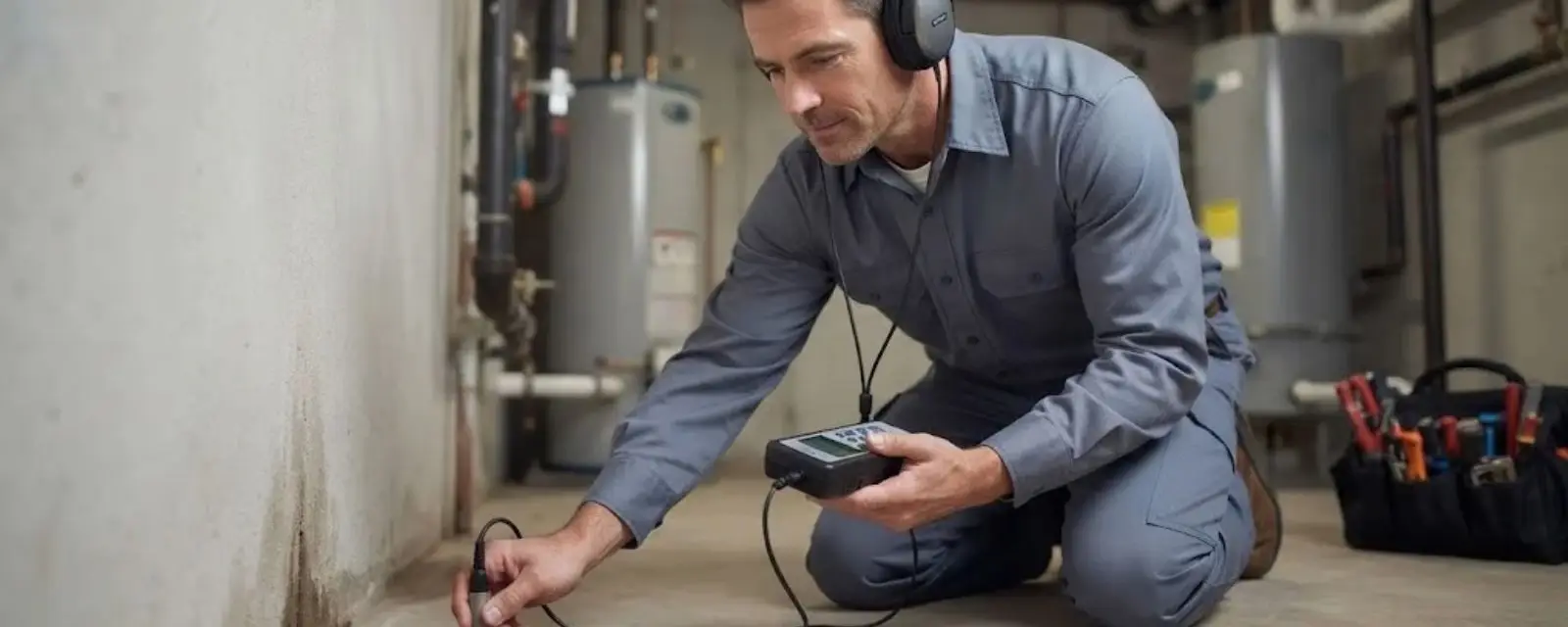
The fastest way to find out whether a water pipe is leaking is a meter test. Turn off every fixture and appliance that uses water, read the meter, wait, and read it again. If the numbers moved, water is going somewhere, and the next job is finding where.
This post covers that test step by step, the signs of a hidden leak, the toilet dye test that catches the most common cause of a high bill, and when to hand the search to a plumber with proper leak-finding tools.
Step one: the meter test with everything off
- 1
Stop all water use
Make sure nobody runs a tap, flushes a toilet, or starts a dishwasher or washing machine. Pause the ice maker, humidifier, and irrigation system.
- 2
Read the meter
Find the meter and note the main reading and the small low-flow indicator, which usually looks like a dial or a triangle.
- 3
Wait and compare
Come back after an hour or two without using any water, then read it again. Movement on the main reading or a spinning indicator means water is flowing.
- 4
Close the house shut-off
Turn off the main shut-off valve inside the house and check the meter once more. If it still moves, the leak is between the meter and the house.
That last check matters because it splits the problem in two: leaks inside the building, and leaks in the buried line that runs to it.
Signs a pipe is leaking before the bill proves it
Some leaks announce themselves. A damp spot on a ceiling, a stain that spreads on a wall, a floor that feels warm underfoot, or the sound of running water when everything is off are all clues.
Others are quieter. Low water pressure, a musty smell in a closet or crawlspace, or a lawn patch that stays soggy long after rain can mean a leak in a buried line or an irrigation pipe.
- Meter keeps running with everything off
- Bill creeping up month after month
- Wet ceiling or wall without a roof leak
- Warm spot on a floor, which can mean a hot water line
- Sound of running water at night
- Soft, green, or sunken ground near the house
The toilet dye test, and why the township points to toilets first
Randolph's township guidance on high water bills says the most common cause is a running toilet, and the second most common is a faulty fill valve. A toilet that runs all the time can waste up to 200 gallons a day or more, and you may never hear it.
Do the dye test with food coloring. Put a few drops in the tank, do not flush, and wait about 20 minutes. If color shows up in the bowl, the flapper is leaking and the toilet is the culprit.
Check every toilet in the house, not only the one you use most. A bathroom nobody uses can leak all month and nobody will notice.
Randolph, NJ: bills, the township meter check, and the water you buy
The township says it usually flags unusual bills, and the Division of Water and Sewer visits to check the meter. If the meter reading is accurate, you may need a plumber. Owners are responsible for the water service from the curb shut-off to the house, so a leak on that stretch is yours to fix even though the pipe is outside.
If you want a meter recheck or a billing question answered, the township's Division of Water and Sewer is the right first call, and after hours the emergency route goes through police dispatch. Ask for the numbers from the township directly, and have your account and meter reading ready.
Randolph buys wholesale water from the Morris County Municipal Utilities Authority, drawn from groundwater at the Alamatong well fields. The township's tables do not report hardness, so we do not blame leaks on water chemistry. If you are curious, ask the water division or test your tap.
Source type: Township High Water Bills page, Water/Sewer page, and Drinking Water Quality Report page
Common sources, ranked by how often homeowners find them
| Source | How to confirm | Who fixes it |
|---|---|---|
| Running toilet | Dye test in the tank | Homeowner or plumber |
| Dripping faucet or shower valve | Look and listen, check the cabinet below | Plumber for a valve, homeowner for a washer |
| Water heater connection or tank | Check the base, look for rust or dampness | Plumber |
| Pipe inside a wall or ceiling | Meter moves with the main off, stain or warm spot | Plumber with leak-detection tools |
| Buried line from the meter to the house | Meter moves, house shut-off closed | Plumber, often with excavation |
| Irrigation or outdoor line | Wet ground, meter moves with the house off | Irrigation or plumbing contractor |
The first row costs almost nothing to check. The last three are the ones that need equipment, which brings us to what a plumber actually does.
How a plumber pinpoints a hidden leak
Guessing means opening walls, and opening walls costs money. Leak detection uses acoustic listening equipment that picks up the sound of escaping water on a pipe, thermal imaging that shows warm or cold patches behind a surface, and pressure testing that isolates one section of the line at a time.
Moisture meters confirm what the other tools suggest, and a tracer gas can find a buried line. The aim is a hole the size of a coaster, not a trench across the yard. Our leak detection service starts there.
We do not promise that every leak can be found without any opening at all. Slab leaks and buried lines sometimes need a small excavation, but the tools tell us where to dig.
After the leak is found: repair options
Fixture or valve repair
Replace the failed washer, cartridge, or supply line. This is the simplest and least disruptive fix.
Spot repair
Cut out the bad section of pipe and join in a new piece. Works when the rest of the line is sound.
Line replacement
When a buried line is corroded or leaks in many places, replacing it may be better than patching again. Our water line repair team handles that.
Emergency shut-down
If the leak is bursting out, shut the main and call right away. See how our burst pipe repair visits work.
When to stop testing and call
Call a plumber if the meter moves with the house shut-off closed, if you see water spreading on a ceiling or floor, or if the leak is in a wall you cannot open. Call at once if water is pouring out or if the floor is soaked near electrical outlets.
You can reach us from anywhere nearby, including Roxbury and Morris Township, and our dispatch runs around the clock.
Leak detection FAQ
Shut off every fixture, read the water meter, wait an hour or two without using water, and read it again. If the numbers moved, water is leaking. Closing the main inside the house and checking again tells you whether the leak is inside or in the buried line.
Yes. Running toilets, leaks in a buried line, and slab leaks can waste water for weeks without any stain. The bill is often the first sign.
About 20 minutes with no flushing. If color from the tank reaches the bowl in that time, the flapper is not sealing. Repeat the test for every toilet.
According to Randolph's own guidance, a faulty fill valve is second after a running toilet. Other causes include guests, irrigation, pool filling, softener cycling, and water-cooled air conditioning.
Usually not. Acoustic, thermal, and pressure tools find the area without cutting, and any opening that follows is small and targeted.
Start with the township Division of Water and Sewer to confirm the meter reading and the curb shut-off, since owners are responsible for the pipe from the curb shut-off to the house. If the meter still reads correctly, call a plumber to trace and repair the line.
Meter still moving with the main closed? Call us to trace the leak.
Call (908) 357-1542Standards and sources used on this page
- Randolph Township drinking water quality report and MCMUA tables
- Randolph Township, Common Causes for High Water Bills page
- Randolph Township Water and Sewer page and Utilities Element