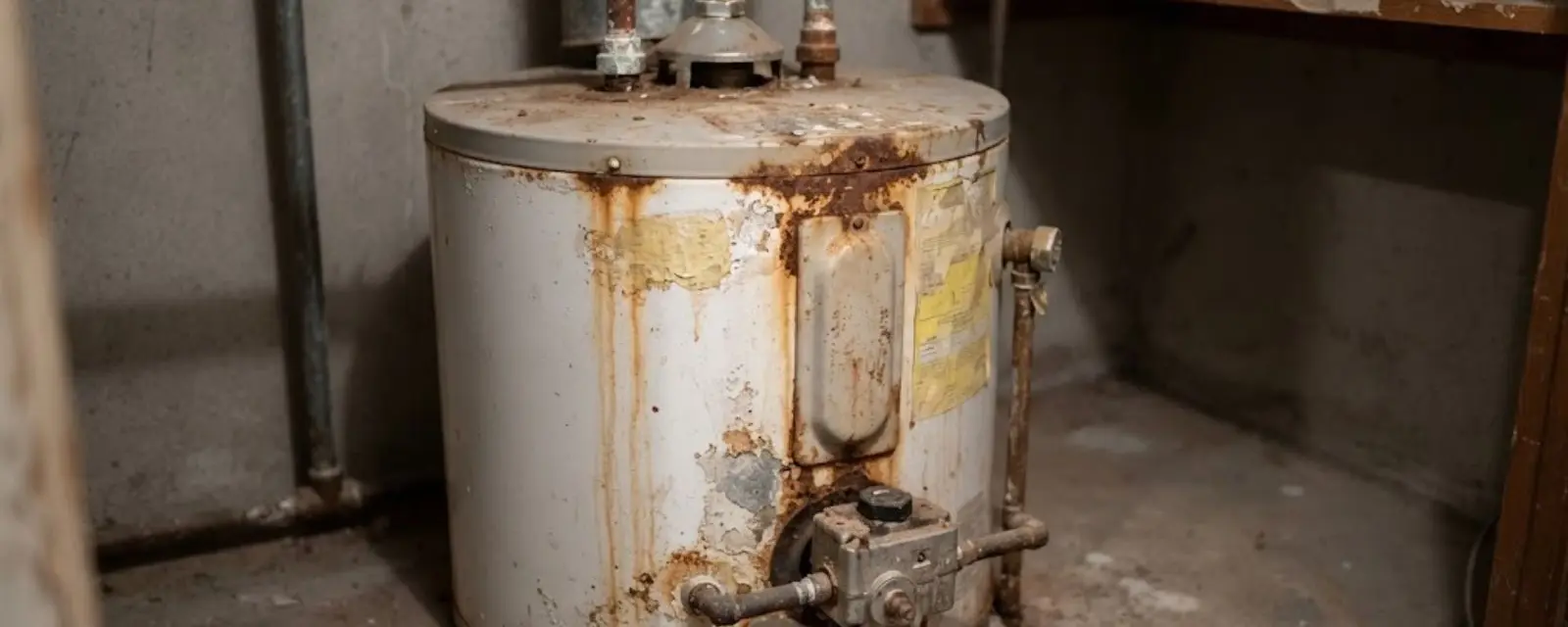
Water heater repair in Randolph, NJ means finding the one failed part, such as a thermostat, heating element, burner assembly, valve or fitting, and fixing it so the tank keeps working. Sometimes the part is cheap to swap and the tank has plenty of life left. Sometimes the tank itself has rusted through and no repair will hold.
We tell you which one it is before any work starts. Call the 24/7 line and a dispatcher sends a licensed plumber to check the heater, the connections and the shutoffs.
When a leaking water heater becomes an emergency
A steady stream from the tank, water spreading across a finished basement, or a ceiling stain under an upstairs unit all call for a same-day visit. The longer the water runs, the more drywall, flooring and stored boxes it reaches. A few drips from a pipe fitting can wait for a scheduled visit, but a puddle that grows cannot.
Shut the cold supply valve above the heater first. Then stop the gas or switch off the breaker, as covered below, and call us.
Water on the floor around the tank? Call the 24/7 line and describe where it is coming from.
Call for dispatchBefore the plumber arrives
Four quick moves limit the damage and keep you safe.
1Close the cold supply
The shutoff sits on the pipe feeding the top of the tank. Turn it clockwise until it stops. If it spins freely or leaks, tell the dispatcher.
2Cut the fuel or power
Set a gas heater's control to off, or flip the breaker for an electric one. Never leave an electric element energized in a tank that has drained.
3Clear the floor
Move boxes, rugs and electronics out of the splash zone. A wet vac or towels buy time if the leak is slow.
4Smell gas? Leave
Walk outside, move well away from the house and call the gas utility or 911 from there. Do not flip switches on the way out.
Leaking from the top, the side or the bottom
Top of the tank
Usually a loose or corroded inlet, outlet or anode fitting. These are often repairable with new connectors or a fresh seal.
Side of the tank
Often condensation or a weeping element gasket on an electric unit. If water seeps from the jacket itself, the inner tank may be failing.
Bottom of the tank
A dripping drain valve can be swapped. Water coming out from under the whole tank usually means the shell has rusted through.
Relief valve pipe
A drip from the discharge pipe means the valve is opening on pressure or heat. It can be a worn valve or a symptom of a bigger problem.
What each symptom usually points to
| Symptom | Likely cause | Repair or replace |
|---|---|---|
| Pool under the tank | Failed drain valve or a through-the-shell leak | Valve is a repair, shell leak means replacement |
| Cold water only | Tripped breaker, dead element, or a failed gas control | Repair in most cases |
| Lukewarm, runs out fast | Burned-out lower element or sediment on a gas burner | Repair, then flush |
| Popping or rumbling | Sediment hardened in the bottom of the tank | Flush first, replace if it persists |
| Rusty hot water only | Corroded tank interior or spent anode rod | Depends on how far corrosion has gone |
| Dripping relief pipe | Worn valve or excess pressure in the system | Repair after the cause is found |
No hot water and how we trace it
Cold showers are the most common reason people call us about a water heater. The cause depends on the fuel. A gas unit with a dead pilot or failed thermocouple behaves differently from an electric unit with a tripped high-limit switch.
- 1
Confirm power or fuel
We check the breaker, the gas supply and the control settings before opening anything.
- 2
Test the parts
A multimeter shows whether an electric element or thermostat has failed. On gas units we inspect the burner, thermocouple and flame sensor.
- 3
Check the tank
We look for moisture, rust streaks and a damp insulation jacket. These tell us whether new parts are worth installing.
- 4
Explain the choices
You hear the repair option and the replacement option, with the reason for each, before we pick up a wrench.
What shapes the cost of a water heater repair
A thermostat swap and a relief valve change are different jobs, so there is no single number. After the plumber inspects the unit you get a clear price before work starts.
Elements, thermostats, valves and burner parts differ in cost and in how long they take to install.
Gas units add venting and combustion checks. Electric units add electrical testing.
A heater in a tight closet or crawlspace takes longer to work around than one in an open basement.
If water has soaked into drywall or flooring, a leak stop is only the first step and other trades may be needed.
When the tank itself has failed, spending on parts rarely pays off, and we will say so.
Homeowner policies differ. Many treat a sudden burst or tank rupture differently from slow seepage over time. Read your policy or call your insurer before you throw away the old unit, since they may want to see it.
Tell the dispatcher what you see and get a plumber headed your way.
Call (908) 357-1542Water temperature, scalds and the thermostat dial
The Consumer Product Safety Commission urges setting water heaters to 120 degrees F. At 150 degrees F, most adults suffer a third-degree burn in about 2 seconds, and at 140 degrees F it takes about 6 seconds. New Jersey's plumbing subcode also sets hot water at no less than 120 and no more than 140 degrees F, so we set repaired units inside that range.
If you have small children or older family members at home, ask us to confirm the setting at the end of the visit. A bad thermostat can run hot as easily as cold.
Repairs, permits and the township
Randolph Township's Office of Construction Codes requires a construction permit for water heater replacement, but routine repair is treated as ordinary maintenance under state rules and is generally exempt. Swapping an element or valve is repair. Pulling out the tank is not. If a visit turns into a replacement, our plumber walks you through the permit step and the township's Office of Construction Codes is the place to ask.
Our water heater replacement page explains that path in more detail, and homeowners weighing a different style of heater can read about tankless units.
What your Randolph water supply means for the tank
Most Randolph homes get water that the township buys wholesale from the Morris County Municipal Utilities Authority, though some homes are on private wells. Randolph's published water tables do not report hardness, so we do not assume how much scale your tank collects. If the bottom of your heater is loud or the water runs cloudy, we flush it and look at what comes out.
A heater that leaks along with a rising water bill may be hiding another loss in the house. That is a job for our leak detection team, and we often check both on the same visit.
Water heater repair questions from Randolph homeowners
The three common causes are a failed drain valve, loose fittings at the top, and a rusted-through tank. The first two can be repaired. A tank leak cannot, because the water is escaping from the inside shell. A plumber can usually tell which one you have within a few minutes of looking.
On an electric heater, a tripped breaker or a dead element is the usual reason. On gas, check whether the pilot is lit or the unit has locked out. If resetting once does nothing, stop and call, because repeated resets can hide a deeper fault.
Yes. The line is staffed around the clock, and a dispatcher sends a licensed plumber for active leaks and tank failures at any hour. Tell them whether water is still flowing so they can prioritize your call.
That valve opens when pressure or temperature climbs too high. A worn valve can drip on its own, but a valve that opens repeatedly may be reacting to a real pressure problem. Do not cap the pipe. It is a safety device.
The failed part, the fuel type, how hard it is to reach the unit, and any water damage around it. We quote a clear price after inspecting the heater and before work begins.
Rust in hot water only often points to the tank interior or a used-up anode rod. Rust in cold water too points to the pipes. We open a hot tap, then a cold one, and compare.
Ordinary repair is generally exempt as maintenance, but replacing the unit needs a construction permit. If you are unsure which applies, ask the Randolph Office of Construction Codes before work starts.
Heater acting up? One call gets a plumber looking at it tonight.
Call (908) 357-1542Standards and sources used on this page
- Randolph Township, Office of Construction Codes, construction permits page
- Randolph Township drinking water quality report and MCMUA tables
- U.S. Consumer Product Safety Commission, tap water scald guidance
- NJ DEP Private Well Testing Act program page
- PSEG public safety guidance on gas leaks (used as a general reference)