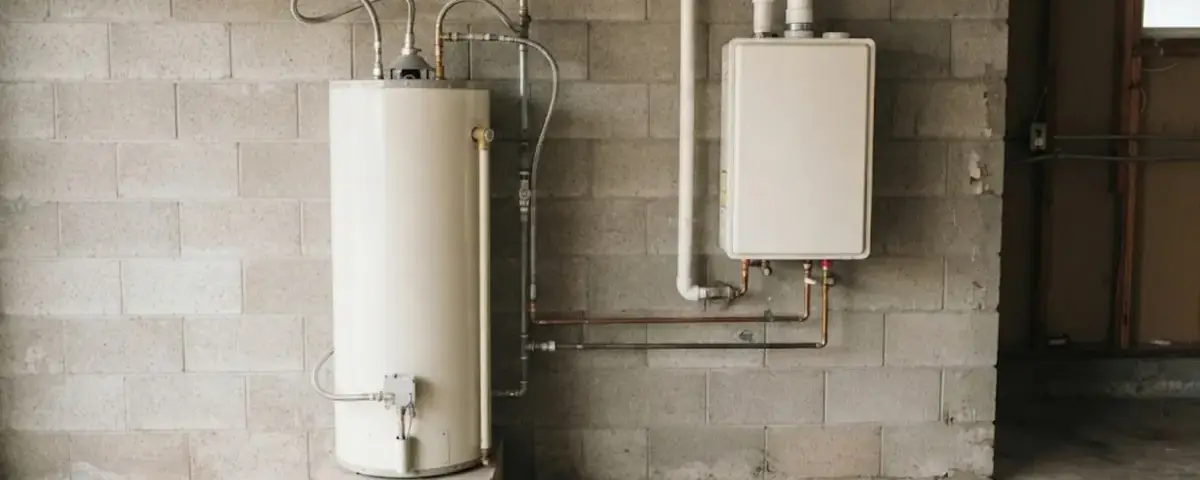
Water heater replacement in Randolph, NJ is the job of draining and disconnecting a failed tank, setting a new unit in its place, and reconnecting water, fuel or power, venting and the safety valve. It is the right call when the tank wall itself has failed, because new parts cannot seal a shell that is rusting from the inside.
If you are staring at a flooded basement floor, close the cold supply to the heater and call. We will confirm replacement is really needed before you commit to it.
Repair or replace the tank
Most homeowners ask this question while standing in water or after a week of cold showers. The honest answer depends on what failed, not on how old the heater looks. A bad thermostat is a small fix. A weeping tank seam is not.
| What we find | Repair makes sense when | Replacement makes sense when |
|---|---|---|
| Water at the base | The drain valve or a fitting is the source | Water seeps from the tank shell or seam |
| No hot water | Element, thermostat or gas control failed | Tank is also leaking or badly corroded |
| Rust in hot water | Anode rod is spent and the tank is sound | Interior corrosion is already flaking |
| Loud popping | A flush clears the sediment | Flushing does not help and the burner or elements keep failing |
| Repeated repairs | One isolated failure | A second or third part fails in a short span |
Water pouring from the heater right now
A tank that is actively leaking cannot be patched with sealant or tape. Water is escaping from inside the steel shell, and the opening will only widen. Shutting the supply valve and draining the tank slows the damage until the new unit goes in.
If the leak is from a connector or the relief valve instead, the answer may be a repair. Our water heater repair crew checks that before replacement is on the table.
Basement floor wet and the heater cold? Call the line and tell the dispatcher what you see.
Call the 24/7 lineGet ready for the swap
A little preparation shortens the visit.
1Stop the water
Close the cold inlet valve on top of the heater. If it will not turn, shut the main and say so on the call.
2Kill power or gas
Flip the breaker for an electric unit or set the gas valve to off. Smell gas and you go outside and call from there.
3Clear a path
Free the route from the door to the heater so the old tank can come out and the new one can go in.
4Know your setup
Note whether your heater runs on gas or electric and roughly how many people use hot water. It helps us bring the right unit.
What happens during a replacement
- 1
Drain and disconnect
We shut off fuel or power, drain the tank to a safe drain or outdoors, and disconnect supply lines, vent and fuel connections.
- 2
Haul out the old unit
The failed tank comes up the stairs or out the door. Corroded fittings and shutoff valves are replaced if they are worn.
- 3
Set and connect the new heater
The new tank is leveled, supply lines and the relief valve with its discharge pipe are connected, and a gas unit's vent is checked for draw.
- 4
Test and set the temperature
We fill the tank, purge air, check every joint for seepage, and set the thermostat to a safe level.
Permits and the township office
Randolph requires a construction permit for water heater replacement. A zoning approval is not part of it. The plumbing subcode form, UCC-F130, is signed and sealed by a licensed plumber unless the work is done by a homeowner in an owner-occupied single-family home.
That is one reason a licensed plumber is the simpler route. The Office of Construction Codes asks people to call during planning, so ask about timing before the old unit comes out if the situation is not an emergency.
Setting hot water where it belongs
New Jersey's plumbing subcode is the National Standard Plumbing Code, 2021 edition, and the state amendment puts hot water at no less than 120 and no more than 140 degrees F. The Consumer Product Safety Commission urges 120. Scalds happen fast at higher settings, with about 2 seconds at 150 degrees F enough for a third-degree burn.
We set the new thermostat in that range and show you the dial, which matters most in homes with kids or older relatives.
How replacement is priced
You will not see a number here because tank size, fuel and the condition of the old connections all change it. A plumber looks at the setup and gives a clear price before work starts.
A larger tank or a different fuel than the one you have costs more to supply and install.
Gas units need a proper vent and gas connection. Old or damaged venting adds work.
Seized valves and corroded connectors are replaced rather than reused.
Attic, crawlspace and tight closets take longer than a basement with a clear path.
Replacement needs a township permit, so permit steps are part of the job.
If the tank ruptured suddenly, your homeowner policy may respond differently than it would for slow seepage. Policies vary, so read yours and ask your insurer what they need, such as photos of the failed unit.
Want a clear price for your setup? Call and describe the heater.
Call (908) 357-1542What the age of Randolph housing means for your heater
About 54% of Randolph's housing units, roughly 5,036, were built before 1980, and about 33% predate 1970. Homes from those eras often have heaters that were replaced once or twice already, with older shutoff valves and supply lines left in place. When we swap a tank in one of these houses we look at the surrounding piping too, since a fresh heater tied to tired fittings invites a new leak.
Homeowners who want something other than a standard tank can compare tankless water heaters, and planned jobs fit our water heater installation process.
Replacement questions we hear in Randolph
Repair if one part failed and the tank is sound. Replace if the shell is leaking, rust is flaking from the inside, or parts keep failing back to back. We explain the reason either way.
Close the cold supply valve above it, turn off the power or gas, and call. Do not touch an electric unit while standing in water.
Yes. The 24/7 dispatch line works through nights, weekends and holidays, and the plumber assesses the failed tank on arrival.
Tank size, fuel type, venting, condition of existing connections and where the heater sits in your house. A clear price comes before work starts.
Yes, a construction permit through the Office of Construction Codes. Zoning approval is not needed for a water heater.
New Jersey lets a single-family homeowner do plumbing in his or her own dwelling, but the township permit and plumbing subcode still apply. Gas connections and venting are where homeowners most often get into trouble.
Yes. Disconnecting and hauling out the old unit is part of the visit.
Tank gone and no hot water? Call now and we get the swap scheduled.
Call (908) 357-1542Standards and sources used on this page
- Randolph Township, Office of Construction Codes, construction permits page
- N.J.A.C. 5:23-3.15 and NJ DCA code adoption table (National Standard Plumbing Code, 2021 edition)
- U.S. Consumer Product Safety Commission, tap water scald guidance
- Randolph Township Housing Element (ACS 2020 tables)