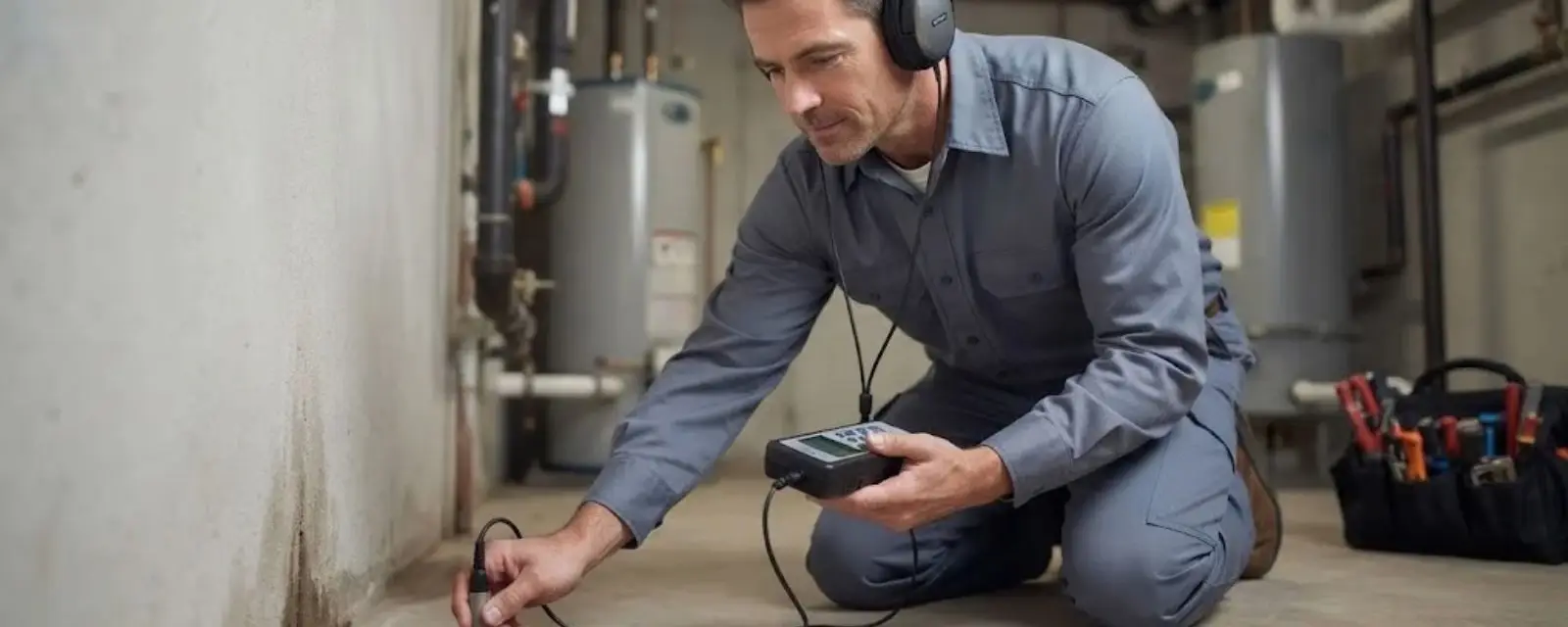
Leak detection is the work of locating a water leak you cannot see, using pressure tests, meter readings and listening or imaging equipment, so the repair can be small and exact. For Randolph, NJ homeowners the call usually starts with a symptom, such as a meter that keeps turning with every fixture off, a bill that creeps up, or a damp patch that appears from nowhere.
A leak that runs quietly for weeks can rot framing, stain finishes and grow mold long before a puddle shows. If a pipe has already split and water is spraying, go straight to our burst pipe repair page or call now, and read the safe steps below while you wait.
Signs of a leak you cannot see
Most hidden leaks announce themselves in small ways. The trick is noticing the pattern, because one odd sign can be a faucet washer while three together almost always means water is escaping inside a wall, floor or buried line.
A meter that will not sit still
Every tap off, every appliance idle, and the dial or low-flow indicator still moves. That is water leaving the system somewhere.
A bill that keeps creeping up
Usage that climbs month after month with no change in your household points to a slow leak or a fixture that never fully stops.
Warm spots and wet surfaces
A floor that feels warm underfoot, a ceiling stain that spreads, or paint that bubbles on a wall are classic signs of a pressurized line leaking.
Sound and pressure changes
Hissing or running water when the house is quiet, or pressure that drops without a clear reason, suggests a break you cannot see.
How to check your water meter for a leak
A meter check takes a few minutes and tells you whether water is leaving the house at all. It also tells us whether to start our search inside the walls or out in the yard.
- 1
Stop all water use
Close every tap, pause the dishwasher and washing machine, and make sure no one flushes a toilet.
- 2
Read the meter
Note the dial position or the small low-flow triangle, and take a photo so you can compare later.
- 3
Wait and look again
Give it at least half an hour with nothing running, then check the meter once more.
- 4
Call with what you saw
If the reading moved, you have a leak. Tell the dispatcher, because it shapes which equipment we bring.
A high water bill is not always a pipe leak
Randolph's own Division of Water and Sewer says the most common cause of a high bill is a running toilet. A toilet that runs continuously can waste up to 200 gallons a day or more, which is enough to move a bill and a meter without a drop on the floor. The township also says a faulty fill valve is the second most common cause.
You can test it yourself. Put a few drops of food coloring in the tank and wait about 20 minutes. If color shows up in the bowl, the flapper is leaking and the fix is a cheap part, not a dig.
Other causes the township lists include guests, irrigation, filling a pool, a softener cycling and water-cooled air conditioning. When the Division sees an unusual bill it usually flags it, and staff visit to check the meter. If the meter reading turns out to be accurate, you may need a plumber, and that is where we come in.
Water pouring from a ceiling or floor right now? Do this first
While the dispatcher sends a plumber, these four moves limit the damage.
1Stop the supply
Close the main valve where the line enters the house. If it will not turn, leave it and say so on the call.
2Keep power away from water
If water is near outlets, a panel or a ceiling fixture, shut off that circuit at the breaker only if you can reach it dry.
3Move what you can
Pull rugs, electronics and stored boxes out of the wet zone and set out buckets under drips.
4Take photos
Snap the damage and the meter before you clean up. It helps the plumber and any later insurance claim.
Which tool finds which kind of leak
No single instrument finds every leak. We pick the method from the symptom, the pipe layout and how much of the structure is open to inspect.
| Method | What it does | Best for |
|---|---|---|
| Pressure test | Isolates a section of pipe and watches for a pressure drop | Confirming a leak exists and narrowing which line |
| Acoustic listening | Microphones and ground sensors pick up the sound of escaping water | Slab, buried and under-yard lines |
| Thermal imaging | Shows temperature differences behind surfaces without opening them | Hot-water leaks, radiant floors, wet drywall |
| Moisture meter | Measures dampness in drywall, wood and subfloor | Mapping how far water has spread |
| Tracer gas | Safe test gas rises from the leak and is sniffed out above ground | Stubborn leaks acoustic tools cannot pin down |
| Camera inspection | A small camera looks inside drain and sewer pipes | Drain lines that leak or seep, not supply lines |
Slab leak detection: water under a concrete floor
A slab leak is a break in a pressurized line that runs under or inside a concrete floor. Telltale signs are a warm spot on the floor, a meter that runs with the house quiet, and the sound of water that you cannot place. If your house has a garage, addition or lower level poured on concrete, it is worth ruling out.
We confirm the leak with a pressure test, then trace it with acoustic equipment and thermal imaging so the opening in the floor is small. Repair choices range from cutting in and patching a short section to rerouting the line overhead. We will lay out both so you can weigh the floor damage against the cost.
A wet ceiling or wall: finding the source
Water travels. A stain on a living room ceiling may start at a bathroom supply line, a shower valve or a roof flashing two rooms away. We track the moisture with a meter and a thermal camera, then open the smallest section of drywall that exposes the pipe.
Tell us whether the stain grows only after rain, only after someone showers, or all the time. Rain-only stains often point to the roof, which is a roofer's job. Stains that grow when a tub fills or a toilet is used point to plumbing, and those we can pin down on the spot.
Leaks under the house or in a buried pipe
Crawlspaces and unfinished basements let us see the pipes directly, so we start with a visual check for drips, green corrosion and damp insulation. A buried line is harder. If the meter runs and nothing inside is wet, the leak may sit underground between the meter and the foundation or along a line to a garage or outbuilding.
For those, we use ground microphones and, if needed, tracer gas to mark the spot on the surface. That lets a repair crew dig one targeted hole instead of trenching the whole yard.
When the leak is on the line from the street
In Randolph, owners are responsible for the water service from the curb shut-off to the house, so a leak on that stretch is yours to fix. We find it with the same listening equipment, then hand the job to our water line repair work for the actual replacement or patch.
A tell for this leak is a soggy patch of lawn, a sunken driveway edge or a meter that runs while every fixture inside is dry.
Irrigation, pool and meter-box leaks
Irrigation systems leak at heads, valves and buried joints, and a zone stuck open can run the meter all night. We shut the system off from the supply side and test the lines to see whether the leak is in the irrigation or in the house feed. Sprinkler head and controller repairs belong to an irrigation specialist.
Pool and spa leaks are trickier because evaporation looks like loss. We test the plumbing lines that feed and return the pool, but we do not repair liners or shells.
Water pooling around the meter box in the yard is worth a quick call. It can be a failing fitting on your side of the meter, and it is far cheaper to fix before the soil washes out.
Leak detection for a commercial building
Shops, offices and multi-unit buildings can hide leaks in ceilings, utility chases and shared risers. We run the same meter and pressure checks, then trace by zone to find the source. Large or complex systems may need coordination with the building's maintenance staff, and our commercial plumbing team handles that side of the job.
Why older Randolph homes get checked first
Township housing data shows about 54 percent of Randolph's 9,356 homes were built before 1980, and about 33 percent before 1970. That age alone does not tell us what your pipes are made of, but it does mean decades of wear on valves, supply lines and fittings. If your house is in that group, a slow leak is more likely, so a meter check is worth doing once a season.
Randolph buys its water wholesale from the Morris County Municipal Utilities Authority, which draws groundwater from the Alamatong well fields. In April 2024 a main break led to a boil water advisory, and residents were told to flush faucets for 3 to 5 minutes and empty ice makers. All that flushing can bump a usage reading, so if a bill from that period looks high, compare it with a fresh meter test before assuming you have a leak.
Where the damage is bad enough to need new lines, we also look at whole-house repiping as an option, and we serve nearby towns such as Dover along the same routes.
What affects the cost of finding a leak
Leak work is priced by how hard the leak is to reach, not by a flat rule. You hear the price before any work starts, and finding the leak is a separate step from repairing it.
A visible pipe in a basement costs less to trace than a line under concrete or beneath a lawn.
A simple pressure test may solve it. A tough leak can need listening, thermal imaging and tracer gas.
Opening tile, plaster or hardwood takes longer and adds patching to the job.
A large house or a multi-unit building has more pipe to isolate and test.
Fixing a short section is a different job from replacing a long run of pipe, and we quote them separately.
Home insurance policies differ. Many treat a sudden burst or accidental discharge differently from a slow leak that went on for months, and some cover the repair but not the search. Read your policy or ask your agent before you call, and ask us for a written description of the work.
Call the 24/7 line and the dispatcher will explain how the price is set for your situation.
Call (908) 357-1542Leak detection questions from Randolph homeowners
The clearest test is the meter check described above. If the meter moves with everything off, water is leaving the system. Rising bills, warm floor spots, damp drywall and the sound of running water add to the case.
Something is using water. Often it is a toilet with a bad flapper, but it can also be a pipe leak inside the house or on the line from the curb. A plumber can separate those by shutting off the house supply and watching whether the meter still moves.
Yes. The line is staffed around the clock, including nights, weekends and holidays. Tell the dispatcher what you see, and shut off the main valve if you can reach it safely.
Price depends on where the leak is, how hard it is to reach and how many methods the search takes. We give you a clear price before work starts, and the repair is quoted separately from the search.
Usually yes. Acoustic listening and thermal imaging narrow the spot to a small area. We only open the floor once the location is confirmed.
Start with the toilets. The township says a running toilet is the most common cause of a high bill, and a dye test in the tank takes about 20 minutes. If the toilets are fine and the meter still moves, call us.
Randolph owners are responsible for the water service from the curb shut-off to the house. If you are unsure which side of that line the leak is on, call the township Division of Water and Sewer or ask our dispatcher.
We can tell whether the leak is in the irrigation piping or the house feed, and we repair the plumbing side. Sprinkler heads and controllers are best left to an irrigation company.
Still not sure whether it is a leak? Call the 24/7 line and describe what you are seeing.
Call (908) 357-1542Standards and sources used on this page
- Randolph Township drinking water quality report and MCMUA tables
- Randolph Township, Common Causes for High Water Bills page
- Randolph Township Water and Sewer page and Utilities Element
- News reports on the April 2024 Randolph boil water advisory
- Randolph Township Housing Element (ACS 2020 tables)