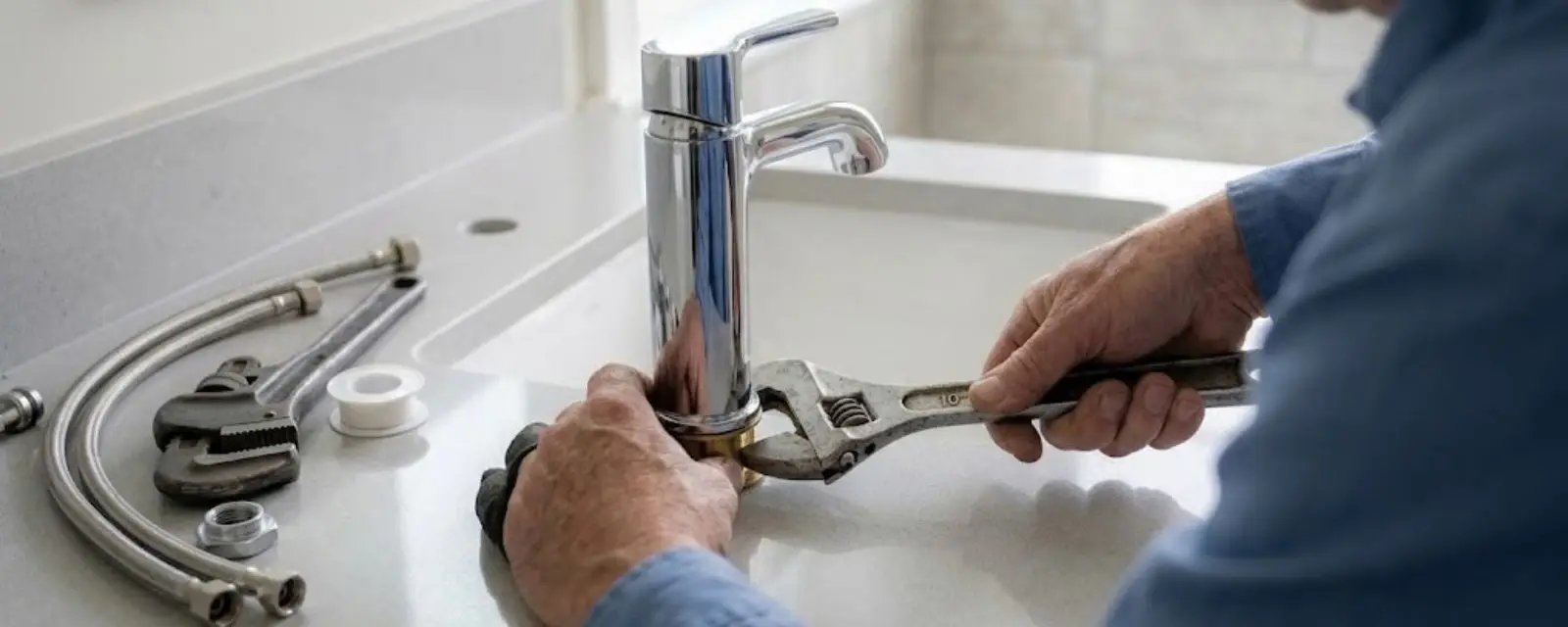
A dripping or leaking bathroom faucet almost always comes down to a worn seal inside the faucet body. In a two handle faucet that is typically a rubber washer or seat. In a single handle faucet it is usually a cartridge or the O-rings around it. If you live in Randolph, NJ, the fix is often a parts swap that takes a plumber well under a visit's worth of time.
The harder question is whether to repair or replace. This guide walks through the faucet types, the parts that fail, a simple decision framework, and what the Randolph permit rules say about swapping a fixture.
Start with where the water shows up
Watch the faucet for a minute with the lights on. A steady drip from the spout means the water is getting past a seal that should be closed. Water pooling at the base of the handle means a worn O-ring or a loose packing nut. Moisture under the sink points at a supply line, a shutoff valve, or the drain connection, and that is a different repair.
Listen too. A faint hiss with the faucet off can mean a pinhole leak in a supply line or a fitting that is slowly weeping. A drip that speeds up when you turn the hot handle suggests the hot side seal has failed first, because heat wears rubber faster.
Single handle or two handle: a quick comparison
The faucet style tells a plumber most of what to expect before the handle even comes off. The table below sorts the usual suspects.
| Faucet style | Where it leaks | Likely worn part | Typical repair |
|---|---|---|---|
| Two handle, compression | Spout drip, hot or cold side only | Rubber washer and brass seat | Replace washer, resurface or replace seat |
| Two handle, ceramic disc | Spout drip or handle base | Quarter turn cartridge or its seals | Replace the cartridge |
| Single handle, cartridge | Spout drip or base of the handle | Cartridge and O-rings | Replace cartridge and O-rings |
| Single handle, ball type | Base of the spout or handle | Springs, seats and O-rings | Rebuild kit or replace the faucet |
| Widespread, three piece | Spout or either handle | Cartridge in one handle | Replace the failed cartridge only |
Washer, O-ring, cartridge: what each part does
Washer and seat
In an older compression faucet, tightening the handle presses a rubber washer onto a brass seat. Over years the rubber hardens and the seat pits, so water slips through even when the handle is snug.
O-ring
A small rubber ring seals the moving stem or spout swivel. When it dries out you see water around the base of the handle or the spout, not a drip from the end.
Cartridge
The cartridge controls flow and mixing in most single handle faucets. Mineral grit, age and wear let water seep past it, and the part is usually replaced whole.
Aerator and spout
Not a leak source, but a clogged aerator raises pressure behind the seal and can make a borderline drip worse. It unscrews and can be rinsed.
Randolph, NJ: permits, ordinary repair and the water bill
New Jersey's construction code treats ordinary maintenance, including routine repair, as exempt from a construction permit. Swapping a washer or a cartridge fits that description, which is why most drip repairs need no paperwork. Replacing the whole faucet is a closer call, so ask before you buy.
Randolph's Construction Permits page says plumbing modifications or improvements, including replacing bathroom fixtures directly, need a construction permit and zoning approval. The township asks you to call during planning. The practical move is to phone the Office of Construction Codes before a full faucet swap, and to let your plumber know what answer you got.
A drip also costs money. The township's own list of high water bill causes puts a running toilet first, so check the toilet before blaming the sink. If the toilet is fine and the bill still climbs, a small leak at the faucet or supply line belongs on the list, and our leak detection visit can sort it out.
Source type: Township pages and NJ DCA UCC guidance
Repair or replace: a decision framework
Run the faucet through four questions. If you answer yes to two or more, replacement usually wins.
- Is the faucet older than the finish on it suggests, with pitted chrome, loose handles or a spout that wobbles?
- Are replacement cartridges or stems hard to find for this model?
- Has the same faucet been repaired before, and is it dripping again?
- Does the sink or the style bother you enough that you would replace it anyway?
If you answered no to most of them, repair is the better value. A worn washer or cartridge in a sound faucet body can run for many more years.
How a plumber fixes it, step by step
- 1
Shut off the water
The stops under the sink close first. If they will not turn or they leak, that becomes part of the job.
- 2
Open the faucet and inspect
We remove the handle and trim, pull the stem or cartridge, and check the seat and the inside of the body for scale or pitting.
- 3
Replace the failed parts
We match the cartridge, washers and O-rings to the brand and model, and coat the new seals with plumber's grease.
- 4
Reassemble and test
The faucet runs hot and cold while we watch the spout, the handle base and the supply connections for any weeping.
Leaks that look like a faucet problem but are not
Not every wet vanity is a faucet issue. A cracked P-trap nut, a weeping braided supply line or a corroded stop valve will all leave a puddle that gets blamed on the tap. Dry the area, lay a paper towel under each connection, and see which one gets wet first.
If the cabinet floor is swollen or the ceiling below has a stain, the leak may be older and larger than it looks. That is the point to stop guessing. Our team can trace it, and our faucet repair visits cover the supply side as well as the spout.
What to do before a plumber arrives
- Close the stop valves under the sink by turning them clockwise.
- Place a small bowl or towel under the drip so you can measure how fast it is leaking.
- Skip the heavy wrench on chrome. Over-tightening cracks fittings and scars the finish.
- Take a photo of the faucet and any brand name on the handle or spout for the parts match.
Bathroom faucet repair questions
A seal inside the faucet is no longer closing completely. In a two handle faucet that is a worn washer or pitted seat. In a single handle faucet it is usually the cartridge.
Many homeowners can swap a cartridge or washer with a screwdriver and the right part. The trouble starts when the stops will not close or the part does not match. In that case a plumber saves a second trip to the hardware store.
A repair is usually the smaller job when the faucet body is sound. Replacement makes sense when the finish is failing, parts are scarce or the same faucet keeps coming back. A clear price is given before work starts.
Most cartridge or washer jobs are a single visit. Corroded stops or a faucet that needs full replacement can add time.
Yes, because a drip runs around the clock. It is small next to a running toilet, which the township names as the most common cause of high bills, but it adds up.
Township guidance lists replacing bathroom fixtures directly as work that needs a construction permit and zoning approval. Simple repairs like a washer or cartridge are routine repair. When unsure, ask the Office of Construction Codes before you buy anything.
Dripping faucet or a wet vanity you cannot explain? Call the line and describe what you see.
Call (908) 357-1542Standards and sources used on this page
- Randolph Township, Office of Construction Codes, construction permits page
- Randolph Township, Common Causes for High Water Bills page