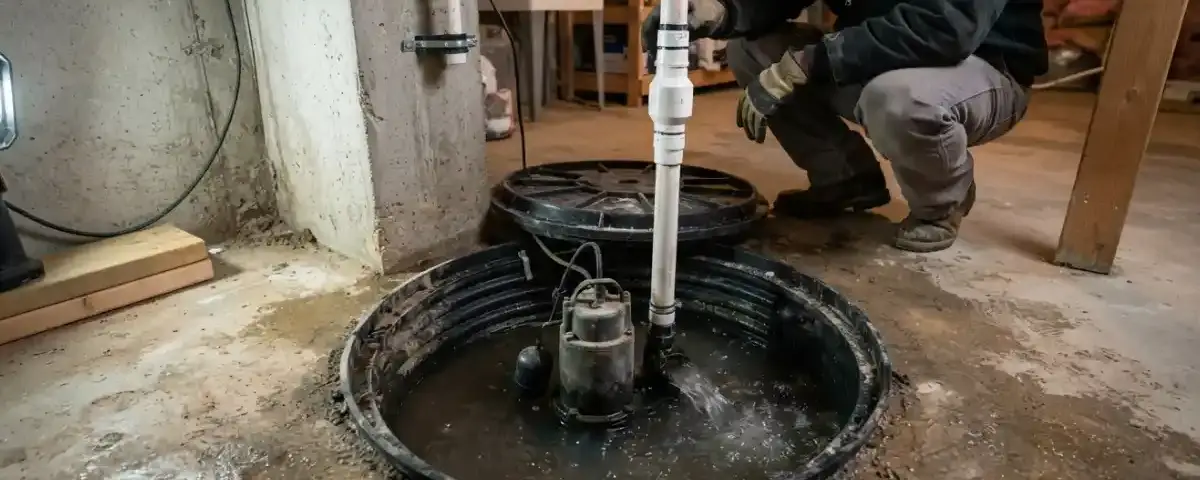
Most submersible sump pump repairs come down to three parts: the float switch, the check valve and the pump motor itself. A pump that will not start usually has a stuck or tangled float, a pump that never stops often has the same float or a failed check valve, and a pump that hums without moving water may have a jammed impeller. The pit and the discharge line matter just as much as the pump.
If you are in Randolph, NJ and standing in a basement with water rising, the first move is to unplug the pump, check that the float moves freely, and call for help if it does not. The sections below explain what each symptom means, what a repair involves, and how to weigh repair against replacement.
Decision guide: repair, replace or add backup
Use this table to match what you see with the likely fix. It is a starting point and a plumber will confirm it at the pit.
| Symptom | Likely cause | Usual path | Why |
|---|---|---|---|
| Pump will not turn on, water rising | Stuck or tangled float, tripped breaker, dead motor | Repair if the motor tests fine, replace if it does not | A float is a small part, a burned motor is not |
| Runs nonstop | Float stuck up, failed check valve, high water inflow | Repair first | Check valve and float are low-cost parts |
| Runs but moves little water | Clogged intake or jammed impeller, frozen or blocked discharge | Clean and repair | Debris is common and easy to remove |
| Loud grinding or rattling | Worn bearings or damaged impeller | Usually replace | Bearing failure tends to repeat |
| Cycles on and off rapidly | Pit too small, check valve leaking back, float set too tight | Repair or adjust | Water flows back into the pit |
| Pump is old and keeps failing | Worn motor and seals | Replace and add backup | Repair costs add up and risk stays |
Float switch problems: the most common failure
The float switch tells the pump when to start and stop. It rises with the water, triggers the motor, and drops when the pit empties. If the float wedges against the pit wall, catches on the power cord or sits in sludge, the pump either never starts or never stops.
Lift the float by hand with the pump plugged in. If it kicks on, the switch works and the float was caught. If nothing happens, the switch may have failed or the pump may be dead. A tethered float is vulnerable to tangling, and a vertical float switch is more tolerant of a narrow pit.
Replacing a switch is a modest repair on a pump that is otherwise healthy. On an older pump, it is worth asking whether the motor has years left before paying to extend its life.
Why a sump pump runs nonstop
A pump that never shuts off has one of three problems. The float may be jammed in the up position, so the pump thinks the pit is full. The check valve may have failed, letting water from the discharge pipe fall back into the pit so the pump pushes the same water again and again. Or water is entering the pit faster than the pump can clear it.
Listen when the pump stops. A loud thump or a rush of water returning to the pit points to the check valve. If the pit is full and the water level is not dropping, the pump may be undersized or the discharge line may be blocked, frozen or kinked.
A pump that runs all the time wears itself out quickly. Treat nonstop running as a repair to do soon, not something to monitor for weeks.
The check valve and why it sticks or fails
A check valve sits on the discharge pipe just above the pump and lets water leave but not come back. Over time the flapper or ball inside wears, and grit can keep it from sealing. A noisy valve with a hard slam on shutoff is a sign it is working hard, and a valve that leaks back will make the pump cycle constantly.
Replacing a check valve is quick compared with replacing a pump. It is also a place where old, glued fittings can be hard to remove, so we cut and rebuild the section with unions that allow service later. A pit and a floor drain are separate systems, so if a basement floor drain also backs up, our drain cleaning team clears that line on its own.
Randolph, NJ: why backup power and nearby river flooding matter
FEMA's basement flooding guide calls a battery backup pump an inexpensive safeguard, which matters because the storms that fill a pit are often the ones that knock out the power. If your pump runs on house current alone, a backup unit is the single upgrade most likely to save the basement when the lights go out. Ask the plumber to size the backup to the same pit.
Next door in Denville, the Morris County hazard plan says flooding along the Rockaway River occurs virtually throughout the entire length of the river within that township. That is a reminder for Randolph homeowners with a sump pit to test the pump in dry weather. A pump that fails a test run is far cheaper to repair now than during a storm.
Source type: FEMA basement flooding guide, Morris County hazard plan
Repair or replace: how we decide
Repair makes sense when the motor is healthy and the failed part is a float, a check valve, a cord or a clogged intake. Replace when the housing is cracked, the motor is burned out, the bearings are noisy, or the pump has failed more than once in a short time. A new pump also gives you a chance to correct the pit and the discharge routing.
Age is a clue but not a rule. Pumps in busy pits work harder and wear sooner than pumps that run a few times a year. We look at how often it cycles, what the pit contains, and whether the pump is the right size for the water it handles.
- Choose repair when only one inexpensive part has failed
- Choose replacement when the motor, housing or bearings are the problem
- Add a battery backup whenever the pit protects finished space or stored belongings
- Keep a second small pump or backup if the pit sees frequent heavy inflow
Maintenance you can do in ten minutes
- 1
Look in the pit
Remove the lid, clear debris, and confirm the pump sits upright and not on gravel or silt.
- 2
Test the float
Pour in water until the float rises and the pump starts, then watch it shut off cleanly.
- 3
Check the discharge
Confirm the outside end of the pipe is clear and drains away from the foundation.
- 4
Test the backup
If you have a battery unit, check the charge indicator and test it on schedule.
Do this before the wet season. If something fails the test, our Roxbury and Rockaway Township customers know the routine: we repair what is repairable and tell you plainly when the pump has had its run. Our service for sump pump repair covers the float, valve and pump.
Sump pump repair questions
A pump that hums without moving water usually has a jammed impeller, a clogged intake screen, an air lock, or a blocked or frozen discharge line. Unplug it before you touch anything, then check the intake and the discharge. If the impeller is damaged, replacement is the better move.
Unplug the pump, lift the float by hand to the top of its range, then plug the pump back in. If the pump starts, the float was stuck or tangled. If it stays silent, the switch or the motor has failed. Keep your hands away from the water while the pump is plugged in.
Yes. If the valve does not hold, the water in the discharge pipe drops back into the pit after each cycle, so the pump has to move it again. You may hear a gush of water returning when the pump stops.
FEMA's basement flooding guide describes a battery backup pump as an inexpensive safeguard against basement flooding. It protects you when the power fails during a storm, which is exactly when the primary pump is needed most.
There is no single number. Life depends on how often it cycles, the quality of the pump, and the state of the pit. A pump in a pit that sees steady inflow will wear out sooner than one that runs a few times a year, so judge by condition and failure history.
We only state what the records show. The Morris County hazard plan describes flooding along the Rockaway River throughout its length in neighboring Denville. For a Randolph basement, the safer approach is to look at your own pit, your own storm history and ask the township about flood risk for your address.
If your pump is silent, stuck on or just old, call us and tell us what you hear.
Call (908) 357-1542Standards and sources used on this page
- FEMA guide to reducing basement flooding