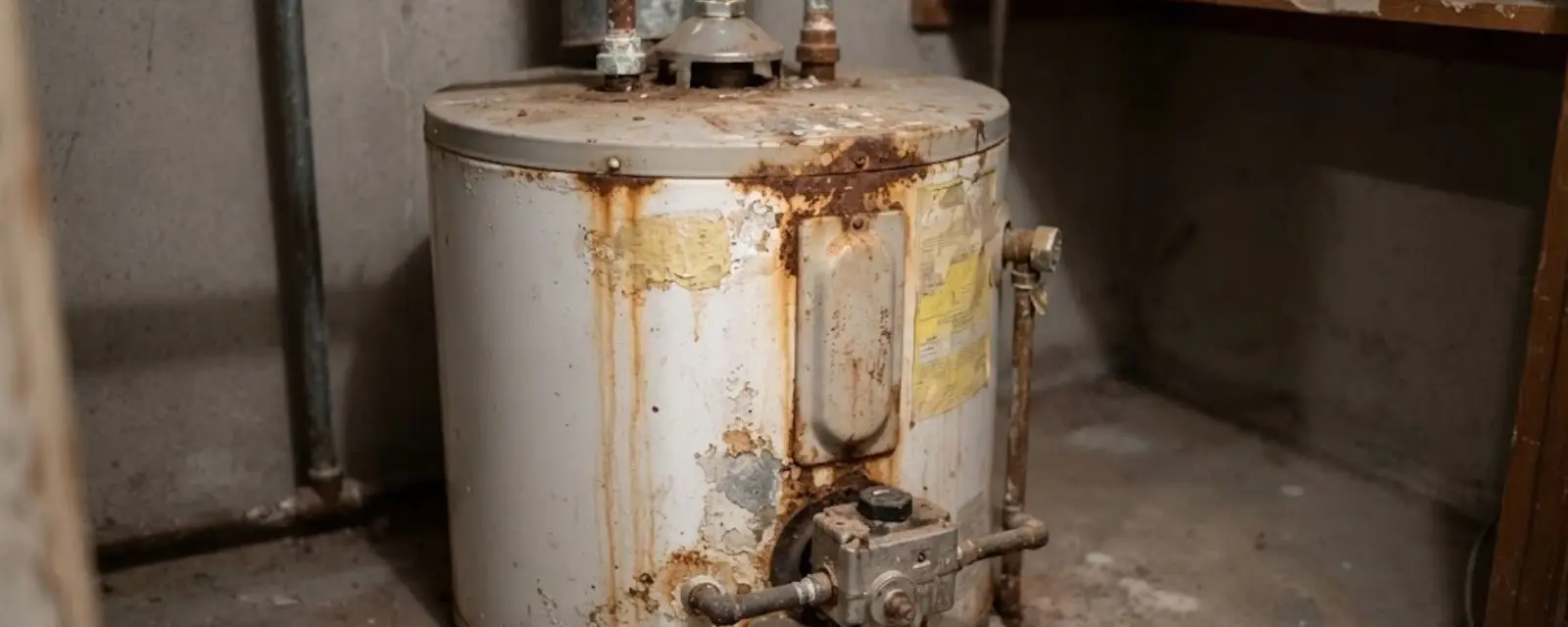
A water heater leaking from the bottom is either a minor fitting problem or a failed tank, and the difference decides everything. A drip from the drain valve, the pressure relief valve discharge pipe, or simple condensation can be repaired or even ignored. Water seeping out of the tank itself cannot be fixed, and the heater has to be replaced.
This post is organized around what to do right now. It starts with how to shut the heater down safely, then helps Randolph, NJ homeowners work out which of the four causes they have.
Shut it down first: the safe order of steps
- 1
Cut the energy
For an electric heater, switch off the breaker. For a gas heater, turn the control to pilot or off. For oil or propane, follow the shut-off on the unit.
- 2
Close the cold supply
Turn the valve on the cold pipe above the heater clockwise until it stops. This ends the refilling of the tank.
- 3
Contain the water
Place towels, a wet vac, or a pan around the base and move anything stored nearby.
- 4
Do not drain a hot tank carelessly
Water inside can be hot enough to scald, and a hose drain should wait until the tank has cooled and you know why you are draining.
Four causes, and how to tell them apart
| Cause | What you see | What it means | Next step |
|---|---|---|---|
| Condensation | Light beading, wet only on cold or high-use days, no steady drip | Humid air or a cold tank, not a defect | Dry it and watch it for a day |
| Drain valve | Slow drip at the small valve near the bottom | Worn valve seat or loose cap | Repair, often a quick valve swap |
| T and P valve discharge | Water at the pipe leading down from the side or top | Pressure or temperature too high, or a worn valve | Plumber to check pressure and expansion tank |
| Tank failure | Steady water from the base or seams, rust streaks | Corroded steel tank | Replace the heater |
| Loose connection | Drip at the cold or hot line fittings above | Failed union or flex hose | Repair the fitting |
The location of the first drop tells most of the story. Dry the area, check again an hour later, and mark where water first appears.
Why a leaking tank cannot be repaired
A tank heater is a steel cylinder with a glass lining and a sacrificial anode rod inside. When the anode is used up, the steel begins to rust from the inside. Eventually a pinhole opens, and water seeps out the bottom or seams.
There is no patch for a corroded tank. Any sealant on the outside only hides the leak briefly, and the weakness spreads. Once the tank is the source, the safe answer is a new unit.
If you are not sure, call before water reaches the floor or the wall. A slow tank failure becomes a flood without warning.
Randolph, NJ: permits and the hot water setting
In Randolph, replacing a water heater needs a construction permit, according to the township construction permits page, and no zoning approval is required for a water heater. The Office of Construction Codes asks that you call during planning. That means a replacement is a scheduled job with paperwork, so ask your plumber how the permit will be handled before the old tank is hauled out.
A new heater is also a chance to set the temperature properly. The Consumer Product Safety Commission urges lowering water heaters to 120 F, and most adults suffer third-degree burns from 2 seconds at 150 F, 6 seconds at 140 F, and 30 seconds at 130 F. If you have children or older adults at home, a lower setting protects them for no extra cost.
Source type: Township Construction Permits page and CPSC guidance
Condensation or leak? A practical test
Condensation appears as light moisture on the outside of the tank or on pipes, not a steady drip. It usually happens when cold incoming water meets warm, humid air. Wipe the tank and the floor completely dry, then place a sheet of paper towel under the base.
Check again after a few hours without using hot water. If the towel stays dry, humidity was the cause. If it picks up water, even slowly, a real leak exists, and you should treat it as one until proven otherwise.
Repair or replace: what to weigh
- Repair a drain valve, a connection, or a T and P valve when the tank itself is dry and the heater is not close to the end of its life.
- Replace the heater when water leaks from the tank body, when rust shows at the seams, or when the unit is old and the repair is only a bandage.
- Ask about an expansion tank if the T and P valve discharges, since thermal expansion in a closed system can push pressure past the valve's setting.
Our water heater repair visits cover the fittings and valves. If the tank is gone, water heater replacement covers sizing, venting, and the permit.
The T and P valve: do not cap it
The temperature and pressure relief valve is a safety device. If it is discharging, the heater or the system is reaching a limit it should not. Never plug the discharge pipe, never cap the valve, and never replace it with a plug.
A plumber will measure the water pressure at a spigot and check for an expansion tank. A valve that drips from age is a simple swap, and one that discharges from high pressure is a system problem.
After the leak: protect the area
Wet insulation and drywall near the heater can hide mold within a day or two, so dry them quickly. Run a fan and open a window if you can. If water went into a finished basement, call your insurer about coverage, since policies differ on sudden leaks and slow ones.
Water heater leak FAQ
The common causes are condensation, a worn drain valve, a discharging T and P valve line, or a corroded tank. If water is steadily seeping from the tank body, the tank has failed.
If the leak is at a valve or connection, yes. If the tank itself is leaking, no. Replacement is the only safe option.
It can be. Water near electrical parts is a shock risk, a gas unit must not sit in water, and a failing tank can release a lot of water. Shut off the power or fuel and the cold supply as soon as you can.
New Jersey's plumbing amendment calls for hot water between 120 and 140 degrees F. The CPSC urges 120 F, because hotter water scalds in seconds.
Only after it has cooled, and only if you know why you are draining it. Hot water from the drain valve can scald.
Yes. Randolph's construction permits page says water heater replacement needs a construction permit, with no zoning approval for a water heater. Call the Office of Construction Codes during planning, and ask your plumber who will file it.
Water pooling under the heater? Shut it down and call us.
Call (908) 357-1542Standards and sources used on this page
- Randolph Township, Office of Construction Codes, construction permits page
- U.S. Consumer Product Safety Commission, tap water scald guidance