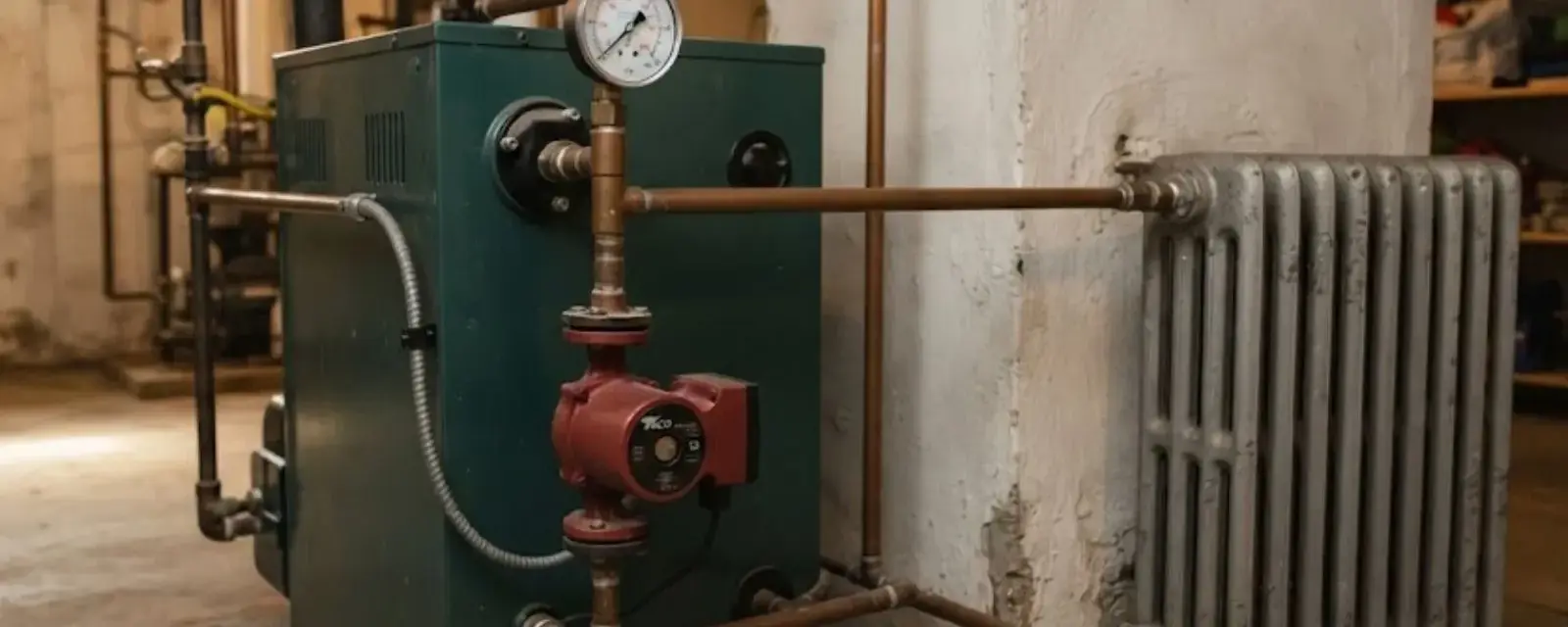
A boiler that is not heating usually comes down to four things: the thermostat is not asking for heat, system pressure has dropped, air is trapped in the lines, or the circulator pump has stopped moving hot water. A boiler that is leaking is a separate problem, because water outside the boiler means a part has failed or the relief valve is discharging.
This guide helps Randolph, NJ homeowners sort the two apart. It covers the checks that are safe to do yourself, the ones that are not, and the point where the right move is to stop and call a licensed plumber.
Start with the thermostat before you blame the boiler
Most no-heat calls begin at the wall. Check that the thermostat is set to heat, that the set point is above the room temperature, and that the display is lit. A dead battery in a battery-powered thermostat looks exactly like a dead boiler.
Then look at the boiler switch and the breaker. Many boilers have a service switch that resembles a light switch, often on or near the unit, and it is easy to knock off during a cleaning.
If the boiler has power and the thermostat is calling, but nothing starts, the problem moves inside the system. Our dispatch also covers Morris Township, and this is the same first sweep we run there every heating season.
Low pressure, air in the lines, and a stuck pump
Look at the pressure gauge on the boiler. If the needle has dropped below the range marked by the manufacturer, the system has lost water somewhere, and many boilers will lock out to protect themselves. Low pressure is a clue, not a diagnosis, because it means water went somewhere.
Air is the next suspect. Gurgling pipes, radiators that are hot at the bottom and cold at the top, or one zone that stays cold all point to trapped air. A circulator pump that hums but does not move water, or does not run at all, gives a similar picture with a warm boiler and cold rooms.
We do not recommend repeatedly adding water to a boiler that keeps losing pressure. Each refill brings in fresh oxygen and minerals, and it hides the leak you actually need to find.
Decision table: what you see and what it usually means
| What you see | Likely cause | Safe homeowner check | Call a plumber when |
|---|---|---|---|
| Whole house cold, boiler silent | Thermostat, power switch, tripped breaker | Replace thermostat batteries, confirm the switch and breaker | Power is on and the boiler still will not start |
| Boiler runs, radiators cold | Air in lines or failed circulator pump | Feel the pipes near the pump, listen for humming | Pump is hot and silent, or bleeding does not help |
| Pressure gauge reads low | Leak somewhere in the system or a weeping relief valve | Look for wet floor, rust trails, drips at the valve | Pressure falls again after a day or two |
| Water pooling under boiler | Failed fitting, tank corrosion, or discharging relief valve | Shut the power, place a pan, take a photo of the source | Any steady drip, or rust at the base of the boiler |
| Short bursts, then shutdown | Safety lockout from low water, flame or flue trouble | Note any error code on the display | Always, because lockouts protect you |
Use the table as a map, not a repair manual. The last column matters most, because several of these causes share the same symptom, and the same checklist applies when we work in Rockaway Township.
Randolph, NJ: replacement permits, gas mains, and alarms
Boiler replacement in Randolph needs a construction permit, according to the township construction permits page. A repair that swaps a part is usually a different matter, but if your plumber says the boiler itself is done, ask the Office of Construction Codes about the permit during planning, before the old unit comes out.
Fuel is not the same on every street here. New Jersey Natural Gas has installed or is installing gas main in parts of town, including Millbrook Avenue and westbound Route 10, but it does not serve every address, and plenty of homes burn oil or propane. Check which fuel your boiler uses before you describe the problem on the phone, because it changes what a technician brings.
If a leak does not seem to come from the boiler at all, the water may be coming from a hidden supply or heating line, and leak detection with acoustic and thermal tools can find it without opening walls at random.
Source type: Township pages, news notices, and NJ state law text
Why boilers leak, and how to read the water
Where the water appears tells you a lot. A drip at the relief valve discharge pipe means the valve has opened, either because pressure climbed too high or because the valve seat is worn. Water at a pipe joint or a circulator flange points to a failed gasket or a corroded fitting.
Water that seeps from the bottom of the boiler body, especially with rust streaks, is the worst case. It often means the heat exchanger or tank has corroded through, and that is usually a replacement conversation, not a repair one.
If a leak does not appear to come from the boiler at all, the water may be coming from a buried or hidden line. Our team can check that with our
Gas smell and carbon monoxide: the rules that override everything
If you smell gas, leave the building at once. Move well away from the house, with at least 350 feet being the distance one New Jersey gas utility advises, and then call your gas utility or 911 from outside. Do not flip switches, strike a flame, or start a car near the odor.
The same rule applies if a carbon monoxide alarm sounds. Get everyone outside into fresh air first, then call for help. A plumber can fix a boiler later, but nobody can fix a poisoned family.
We do not give response times for gas situations, because the utility controls that part. What we can do is inspect and repair the boiler once the building has been cleared and declared safe.
What a plumber checks, and in what order
- 1
Controls and power
Confirm the thermostat call, power supply, and any lockout code before touching a wrench.
- 2
Pressure and expansion
Read the gauge cold and hot, and test the expansion tank, since a waterlogged tank makes pressure spike and the relief valve open.
- 3
Pump and zone valves
Check that the circulator spins and that each zone valve opens when its thermostat calls.
- 4
Leak source
Dry the area, run the system, and trace the water to the exact fitting, valve or tank seam.
- 5
Combustion safety
Look at the burner or igniter, the flue, and the venting, because a safe boiler is one that exhausts properly.
Repair or replace: an honest way to decide
A pump, a zone valve, an expansion tank, a thermostat, and a relief valve are all common parts that can be swapped without replacing the boiler. If the unit is otherwise sound, these repairs are usually the sensible choice.
Replacement enters the picture when the heat exchanger has failed, when the boiler leaks from its body, or when repairs keep following each other every few months. Ask for the cause in plain words and ask whether the repair addresses the cause or only the symptom.
If the leak is in the hot water side and not the heating loop, the right visit may be a water heater repair instead, and for the heating loop itself our boiler repair team starts with the checks above.
Boiler questions Randolph homeowners ask
That pattern points to air in the lines, a failed circulator pump, or a zone valve that is not opening. The boiler is making heat, but the water is not reaching the radiators or baseboards. A plumber can bleed the system, test the pump, and check each zone.
No. A small amount of moisture at a fitting still means a part is failing, and it tends to get worse. A slow drip at the relief valve discharge pipe also needs attention, because it points to pressure or valve trouble.
Not repeatedly. If pressure keeps dropping, water is leaking out somewhere, and each refill adds fresh oxygen that speeds corrosion. Find the cause instead of topping it off.
Yes. Switch off the power at the boiler switch or breaker, place a pan under the leak, and close the water feed if you can find it. Do not touch anything if the floor around the boiler is flooded and the electrical panel is nearby.
Yes. The township construction permits page lists boiler replacement as needing a construction permit. Call the Office of Construction Codes during planning, and ask your plumber who is pulling the permit.
Look for a gas line with a shut-off valve at the boiler, an oil tank in the basement or yard, or a propane tank outside. Natural gas mains are being extended in parts of town, but not every address has one. Tell the dispatcher what you see, and the right technician and parts can be sent.
Cold rooms or a wet boiler floor? Call and describe what you see.
Call (908) 357-1542Standards and sources used on this page
- Randolph Township, Office of Construction Codes, construction permits page
- NJ Korman and Park's Law, P.L. 2015, c.146
- PSEG public safety guidance on gas leaks (used as a general reference)