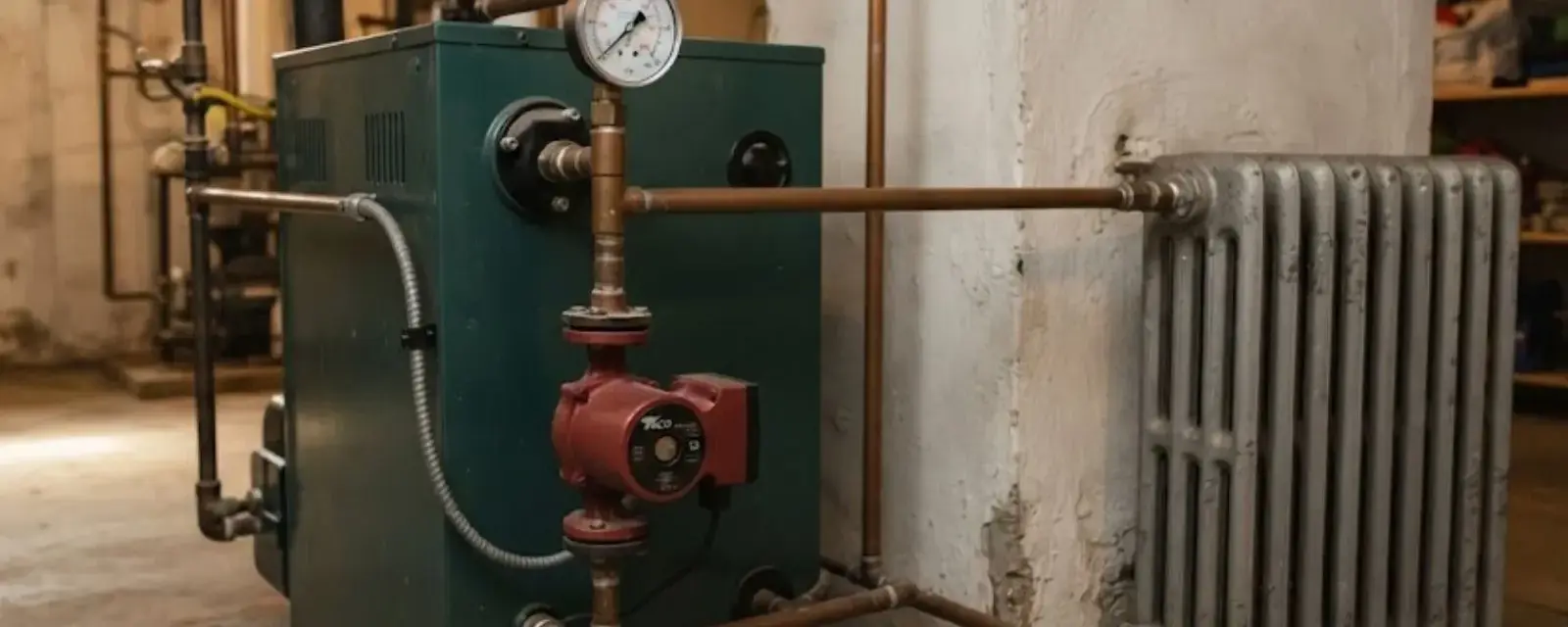
Boiler repair in Randolph, NJ starts with a simple question. Is it heating water that never reaches your radiators or baseboards, or is it failing to heat at all? A boiler warms water and sends it through pipes to radiators, baseboard units or in-floor loops, so the fault could be in the burner, the controls, the pump, the pressure or the air trapped in the loop.
Tell the dispatcher what you see on the gauge, what you hear and what the house feels like. We send a plumber who sorts it out.
Do these four things while you wait
A cold house is stressful, but the first steps are short.
1Smell gas? Go outside
Leave at once, move well away from the building, then call the gas utility or 911 from outside. Do not flip switches or use flames.
2Look at the gauge
Note the pressure reading and whether the boiler shows an error code. Read it out to the dispatcher.
3Check for standing water
If water is pooling under the boiler, shut the feed valve if you know where it is and keep people away from wet electrical gear.
4Do not keep resetting
One reset is fine. Pressing the button again and again can hide a safety lockout that needs a real fix.
No heat in the house, and when it cannot wait
A heating system that quits overnight, with a baby, an older relative or someone medically fragile in the house, is an emergency. So is any boiler leaking steadily or making a sound like a kettle about to boil over. A boiler that is simply short-cycling in mild weather can wait for a scheduled visit.
House cold or boiler leaking? Call now and tell the dispatcher what you see.
Call for dispatchWhat your boiler is trying to tell you
| What you notice | What may be happening | First check |
|---|---|---|
| Radiators cold, boiler running | Air in the loop or a stalled circulator pump | Bleed and pump test |
| Boiler off, thermostat calling | Failed control, tripped limit or no fuel | Controls and fuel supply |
| Pressure drops often | A small leak or a failing expansion tank | Gauge, valve and tank check |
| Pressure climbs high | Waterlogged expansion tank or faulty fill valve | Relief valve and fill valve |
| Banging or kettling | Scale or low flow through the heat exchanger | Flow and exchanger inspection |
| Drip beneath the unit | Fitting, valve or a leaking heat exchanger | Trace the water to its source |
How we diagnose a boiler
- 1
Read the gauges and codes
Pressure, temperature and any fault code narrow the list fast.
- 2
Check fuel and power
We confirm the unit is getting what it needs, whether that is gas, oil or electricity, and do not assume which you have.
- 3
Test the loop
We feel pipe temperatures, listen for the pump and bleed trapped air from radiators or zones.
- 4
Look for water
Wet insulation, rust trails and mineral stains point to the source of a slow leak.
If the fault sits outside what we repair, such as a burner problem that needs a specialist, we say so plainly instead of guessing.
A boiler that leaks or keeps losing pressure
Small drips often come from a valve packing or a loose fitting and are usually simple to correct. Water coming from the heat exchanger or the bottom of the boiler body usually means the unit is nearing the end of its useful run. We tell you which, with the reason.
A system that keeps needing water may be leaking somewhere else in the pipes. Our leak detection work finds those losses inside walls and floors.
What goes into a boiler repair price
Boilers vary too much for a number on a web page. After diagnosis you get a clear price before work starts, and replacement is only raised when repair is not sensible.
Gas, oil and electric boilers have different parts and different testing steps.
A circulator pump, expansion tank, control board and heat exchanger are very different repairs.
Boilers in tight utility rooms take longer to reach and service.
Older boilers can have parts that are hard to source, which affects repair versus replace.
A common part may be fixed in one visit, while a specialty part can mean a second trip once it arrives.
Homeowner policies treat a sudden burst or discharge differently from long-term seepage, and the boiler itself may be treated differently from the damage it causes. Read your policy or ask your agent before assuming either way.
Not sure what you are facing? Call and describe the symptoms.
Call (908) 357-1542Gas, carbon monoxide and your alarms
Homes in Randolph may heat with gas, oil or propane, and New Jersey Natural Gas serves parts of town but not every address. Whatever the fuel, a fuel-burning boiler can produce carbon monoxide if it is not burning or venting properly. New Jersey's Korman and Park's Law requires CO alarms in existing covered structures unless there is no CO hazard, so test the one near your boiler room.
If an alarm sounds, get everyone outside and call 911. Do not go back in to reset anything.
Repairs versus replacing the boiler in Randolph
Replacing a boiler requires a construction permit from Randolph's Office of Construction Codes. A repair such as a pump or valve swap is ordinary maintenance in most cases, but the township decides specifics. If our plumber concludes your boiler is beyond saving, we explain the permit step and what to ask the office.
Roughly 54% of Randolph's homes were built before 1980, so many have older heating systems with older piping. Replacing one often means looking at the pipes around it too. For hot water issues in a house with a boiler, see water heater repair, and if new piping or controls are part of a project, plumbing installation covers it.
Boiler repair questions
Common reasons are air in the loop, a stalled pump, a failed control, a tripped safety limit or no fuel. A plumber checks them in order, starting with the gauge.
Often a fitting, valve or relief valve. If the water comes from the boiler body or heat exchanger, the unit may be failing and replacement may be the better path.
Yes. The 24/7 line takes no-heat and leak calls at any hour. Tell the dispatcher the pressure reading and whether water is escaping.
Mineral buildup or poor flow can cause the water to overheat in spots. Switch the boiler off if it sounds violent and have it checked.
It varies by system, and the label or manual gives the target. A reading that keeps falling or climbing is the signal to call.
The fuel type, the part that failed, access, and the age of the system. You get a clear price before work starts.
Yes, Randolph requires a construction permit for boiler replacement. Call the Office of Construction Codes during planning.
Cold house tonight? Call and a plumber starts on it.
Call (908) 357-1542Standards and sources used on this page
- Randolph Township, Office of Construction Codes, construction permits page
- NJ Korman and Park's Law, P.L. 2015, c.146
- Randolph Township Housing Element (ACS 2020 tables)
- PSEG public safety guidance on gas leaks (used as a general reference)