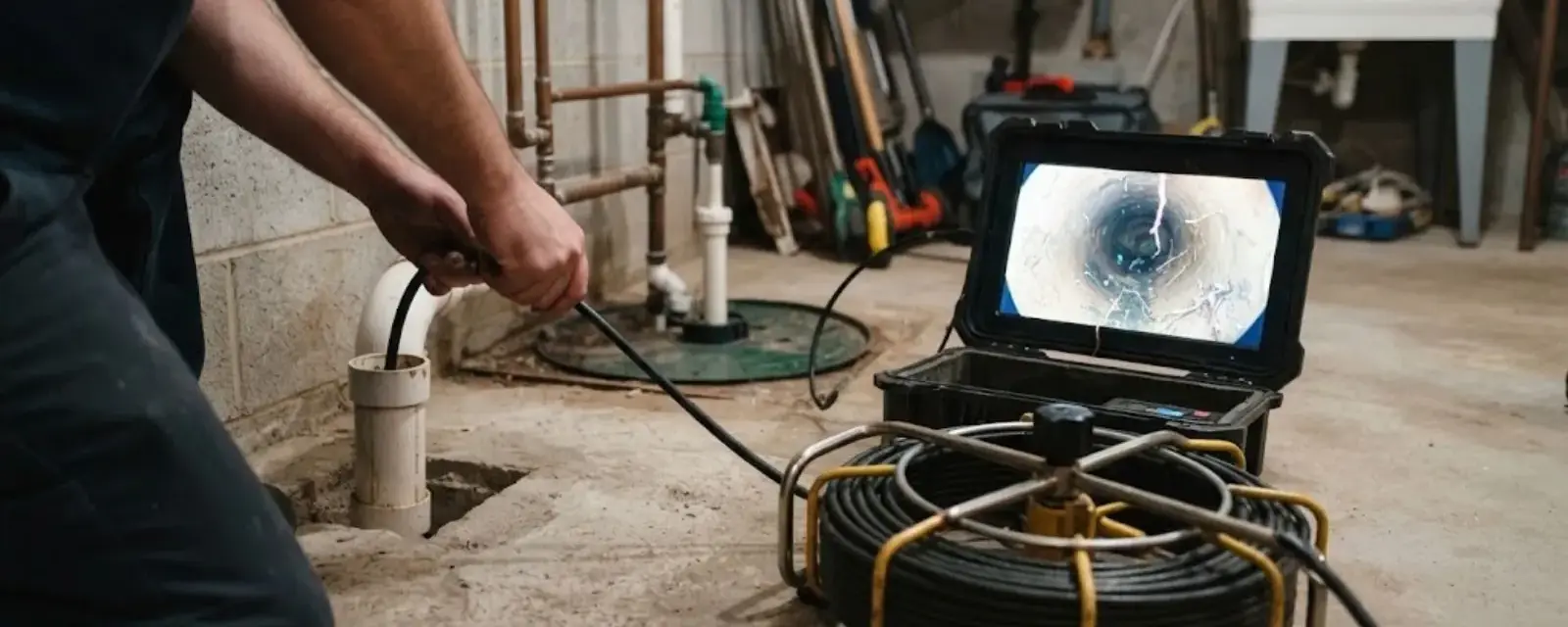
A sewer inspection in Randolph, NJ sends a waterproof camera through your main drain line so a licensed plumber can see its real condition. The camera records roots, cracks, offsets, sags and buildup, and a locator marks where each one sits above ground.
This is a planned visit, not an emergency call. It suits home buyers, owners with repeat clogs and anyone about to put money into a yard, driveway or addition. If sewage is coming up now, the 24/7 line also reaches us, but this page is about looking before something fails.
Buying a house in Randolph? Look at the sewer before closing
A home inspection normally does not follow the main drain out to the street. A camera does. Putting one through the line during the inspection period shows whether the seller is handing you a root-filled or cracked pipe, and the footage gives you something concrete to negotiate with.
If the house is on a private well, the sale involves a separate step. New Jersey requires well water to be tested at sale under the Private Well Testing Act, and a certified lab does that. Plumbers do not. Ask your agent to schedule it alongside the sewer camera so closing is not delayed by either.
What the camera finds
- Roots entering at joints, and how thick they are
- Cracks, breaks and missing pipe sections
- Bellies, where the pipe has sagged and holds water
- Offsets, where joints sit out of line
- Scale and grease coating the wall
- Connections, including where a second line joins
We note the pipe material when it is visible. That is useful because a house's age does not tell you what is under it. Randolph's housing is mixed, with 54 percent built before 1980, so each line has to be looked at on its own.
How a camera inspection works, step by step
- 1
Pick the entry point
The plumber uses a cleanout if there is one. Otherwise a toilet is pulled or a roof vent is opened.
- 2
Run the camera
A flexible rod feeds the camera along the line while it records.
- 3
Locate faults
A receiver above ground picks up the camera's signal and marks depth and position.
- 4
Review together
You see the footage, and the plumber explains what matters and what does not.
Sewer or septic: what the inspection covers
Randolph's public sewer has 82 miles of main and 10 pumping stations, but the township owns no treatment plant. Where homes sit on septic instead, the camera still looks at the line from the house to the tank. It does not inspect the tank, and the tank needs its own check.
We cannot see into the public main past your property line. If the footage suggests the trouble is beyond it, we tell you and you can bring that evidence to the township's Division of Water and Sewer.
Reading the results: what to do next
| What the camera shows | What it usually means | Next step |
|---|---|---|
| Clean pipe, good slope | Line is in order | Nothing needed, keep footage for records |
| Grease or scale coating | Narrowing bore, repeat clogs likely | Cleaning, often hydro jetting |
| Fine roots at a joint | Joint is leaking slightly | Cut roots, plan to seal the joint |
| Crack, collapse or large offset | Pipe has failed | Sewer line repair options |
| Belly holding water | Settled section | Repair or replacement of that run |
Not every finding means digging. A small coating can be cleaned, and a minor root problem can be monitored. The point of the inspection is to separate what needs money now from what can wait.
Permits and repairs that follow an inspection
Inspecting is not construction, but repair might be. New Jersey requires a construction permit for work on existing buildings, though ordinary maintenance including routine repair is exempt. The local enforcing agency decides where a given job falls.
If the camera leads to piping work, ask the Randolph Office of Construction Codes before work starts. If it only calls for clearing a clog, a drain cleaning visit may cover it.
Pricing a sewer camera visit
A camera visit is a scheduled service, so the price is set before we arrive and does not vary with the hour. These points shape it.
A short run to a nearby connection is quicker than a long one to the street.
A cleanout makes entry simple. Without one, fixtures may need to be removed.
If debris blocks the camera, the line must be cleared before it can pass.
Marking fault depth and position above ground adds time to the visit.
Buyers often need footage and notes for the sale, which takes extra preparation.
Inspections are normally paid out of pocket. Some insurers want camera footage before they will write or renew cover on an older home, and others ask for it when you file a sewer claim. Check what your policy says.
Call to book a time and get the price before the camera goes in.
Call (908) 357-1542Sewer camera and locating: your questions
A plumber feeds a small waterproof camera through your main drain line, recording what it sees on video. It shows cracks, roots, sags and buildup without any digging.
Yes. The camera head sends a signal that a receiver above ground picks up, so the plumber can mark the position and depth of any problem. This helps if you are planning to dig.
It is a sensible step, especially for an older home. The home inspection does not usually cover the main line, so the camera fills the gap and gives you footage to use in negotiation.
The price depends on line length, access, whether the pipe needs pre-cleaning, locating and the documentation you need. You hear a clear price before the visit.
No. Well water testing at sale is a separate lab job required under New Jersey rules. A plumber does not perform it.
Yes. Roots are among the most common findings, and the camera shows where they enter and how thick they are.
It depends on the line and access. A straightforward run is quick, while a blocked line must be cleared before the camera can pass. We confirm the plan when you book.
Ready to see what is in your pipe? Call to book a camera inspection.
Call (908) 357-1542Standards and sources used on this page
- Randolph Township, Office of Construction Codes, construction permits page
- Randolph Township Water and Sewer page and Utilities Element
- Randolph Township Housing Element (ACS 2020 tables)
- NJ DEP Private Well Testing Act program page