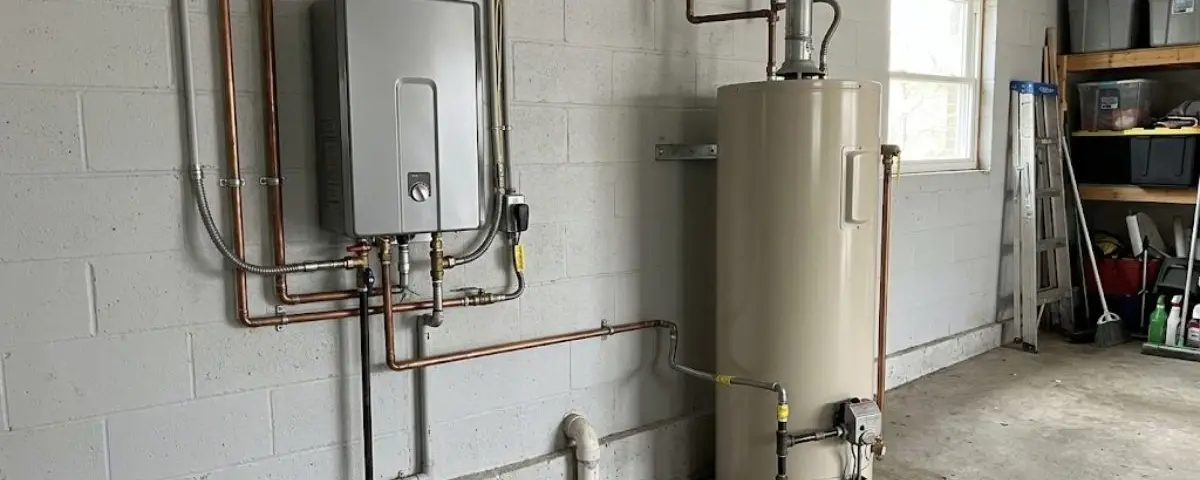
A tankless water heater in Randolph, NJ heats water only as it flows, so there is no tank to fill, store or leak. That makes sizing the main decision. A unit that is too small gives you lukewarm showers when two fixtures run together, and no amount of adjusting fixes it afterward.
We help with the math, the gas or electric supply, the vent, and later with the flushing every tankless unit needs. Call and we start with your fixtures, not with a product.
Size by flow and temperature rise, not tank gallons
Tankless units are rated by the maximum temperature rise they can deliver at a given flow rate in gallons per minute. Tank gallons do not convert to GPM, so a 50-gallon household cannot be matched by guessing. The Department of Energy method adds up the fixtures you run at once, then compares that flow to the unit's rise rating.
Rise is the temperature you want out minus the temperature coming in. If you assume 50 degrees F in and 120 degrees F out, the rise is 70 degrees.
Adding up what runs at the same time
| Fixtures running | Flow in GPM | What it means |
|---|---|---|
| Kitchen faucet | 0.75 | Light demand on its own |
| Shower | 2.5 | Single largest draw in most homes |
| Faucet plus shower together | 3.25 | A realistic two-fixture load to size for |
| Gas unit, typical rating | About 5 at a 70 degree rise | Can cover more than one fixture |
| Electric unit, typical rating | About 2 at a 70 degree rise | May fall short of one shower plus a faucet |
That last row matters. An electric unit that covers a single shower may struggle once someone runs the kitchen tap. Count your heaviest hour, not your average one.
Will your existing gas line carry a tankless burner
A tankless burner fires harder than a tank burner, so it draws more gas at once. The pipe that fed an older tank heater may be too small, and that is a common surprise on a quote. We check the line size, run length and meter capacity before recommending a gas model.
Gas is not on every street in town. New Jersey Natural Gas is adding main in parts of Randolph, and homes may use gas, oil or propane, so we confirm what you have first. If any gas smell shows up, go outside and call the utility or 911 from there.
Flushing and descaling a tankless heater
Minerals in the water collect inside the heat exchanger and slow heat transfer. You notice it as temperature swings, longer waits for hot water, or an error code on the display. Randolph's published water tables do not report hardness, so we do not guess how fast buildup happens in your home.
- 1
Isolate the unit
Power and fuel go off and the isolation valves are closed.
- 2
Circulate descaling solution
A small pump pushes a descaling solution through the exchanger for a set time.
- 3
Flush clean
Fresh water rinses the solution out, and the inlet screen is cleaned.
- 4
Restart and test
We bring the unit back up and check temperature stability and error codes.
Flickering temperature or an error code? Call and book a flush.
Call to schedulePricing a tankless job
Tankless work varies more than tank work, so figures here would mislead. A plumber measures the house, then gives you a clear price before work starts.
A higher flow rating costs more and may need larger fuel or electrical supply.
Undersized gas pipe or a missing electrical circuit is the biggest add-on we see.
Tankless gas units use specific vent materials and routes that differ from a tank flue.
New isolation valves, a condensate path and relocated pipes add labor.
Replacing a water heater needs a Randolph construction permit.
A planned conversion is usually outside insurance. If a tank failed and flooded the space first, your policy may treat that sudden event differently from gradual leaking, so read it and ask before disposal.
Want numbers for your house? Call and we walk through it.
Call (908) 357-1542What Randolph needs on paper
Water heater replacement requires a construction permit from the township's Office of Construction Codes. Zoning approval is not part of it. The state plumbing subcode is the 2021 National Standard Plumbing Code, New Jersey edition, with hot water held between 120 and 140 degrees F.
That temperature range matters with tankless units, because many have a digital setpoint. We set it to a safe level so a child at the sink is not caught off guard.
Where tankless works well and where it does not
Good fit
Households with predictable use, a gas supply that can be upgraded, and a wall location with a clear vent path.
Needs care
Large families running several showers at once, or homes with an undersized gas line or limited electric panel.
Less obvious benefit
No tank means no tank rupture, though connections and valves can still leak and need service.
Honest limit
A short wait at the tap while the unit fires up is normal for on-demand heaters.
Looking at a tank instead? Our water heater installation page compares fuel types. Unit already installed and misbehaving? Start with water heater repair. If your plan involves new gas or water piping, plumbing installation covers it.
What to do if a gas tankless unit faults or smells wrong
A tankless unit burns gas and vents exhaust, so a fault code is not the same as a dripping faucet. These steps keep people safe until a plumber looks at it.
- If you smell gas, leave the building at once, move well away, and call the gas utility or 911 from outside. Do not use switches or flames on the way out.
- If a carbon monoxide alarm sounds, get everyone outside into fresh air and call 911. New Jersey requires CO alarms in existing covered homes under Korman and Park's Law.
- Do not relight, bypass or reset a unit that keeps faulting. Repeated resets can hide a venting or gas problem.
- If water from the tap feels scalding, lower the temperature setting. CPSC urges 120 F, and most adults suffer third-degree burns from two seconds at 150 F.
Tankless questions answered
Add the flow of the fixtures you run at once, then check the unit's rating at your temperature rise. A faucet at 0.75 GPM plus a shower at 2.5 GPM is 3.25 GPM, for example.
The unit is isolated, a descaling solution is circulated through the heat exchanger, and the system is rinsed. We do it for you, including the inlet screen.
Unit capacity, gas line or electrical upgrades, venting, piping changes and permit work. A clear price comes before work starts.
Possibly not. These burners draw more gas than tank burners, so the line size and length need to be checked.
Tank gallons do not convert to GPM, so we size by your fixtures and temperature rise instead. A typical gas unit handles about 5 GPM at a 70 degree rise.
Typical electric units deliver about 2 GPM at a 70 degree rise, which may only cover one fixture. Heavy-use homes often need gas.
Yes. Replacing a water heater needs a construction permit, and the Office of Construction Codes asks to be called during planning.
Ready to size one for your home? Call and give us your fixture list.
Call (908) 357-1542Standards and sources used on this page
- Randolph Township, Office of Construction Codes, construction permits page
- N.J.A.C. 5:23-3.15 and NJ DCA code adoption table (National Standard Plumbing Code, 2021 edition)
- U.S. Consumer Product Safety Commission, tap water scald guidance
- U.S. Department of Energy, Energy Saver guide to sizing a new water heater
- NJ Korman and Park's Law, P.L. 2015, c.146
- PSEG public safety guidance on gas leaks (used as a general reference)