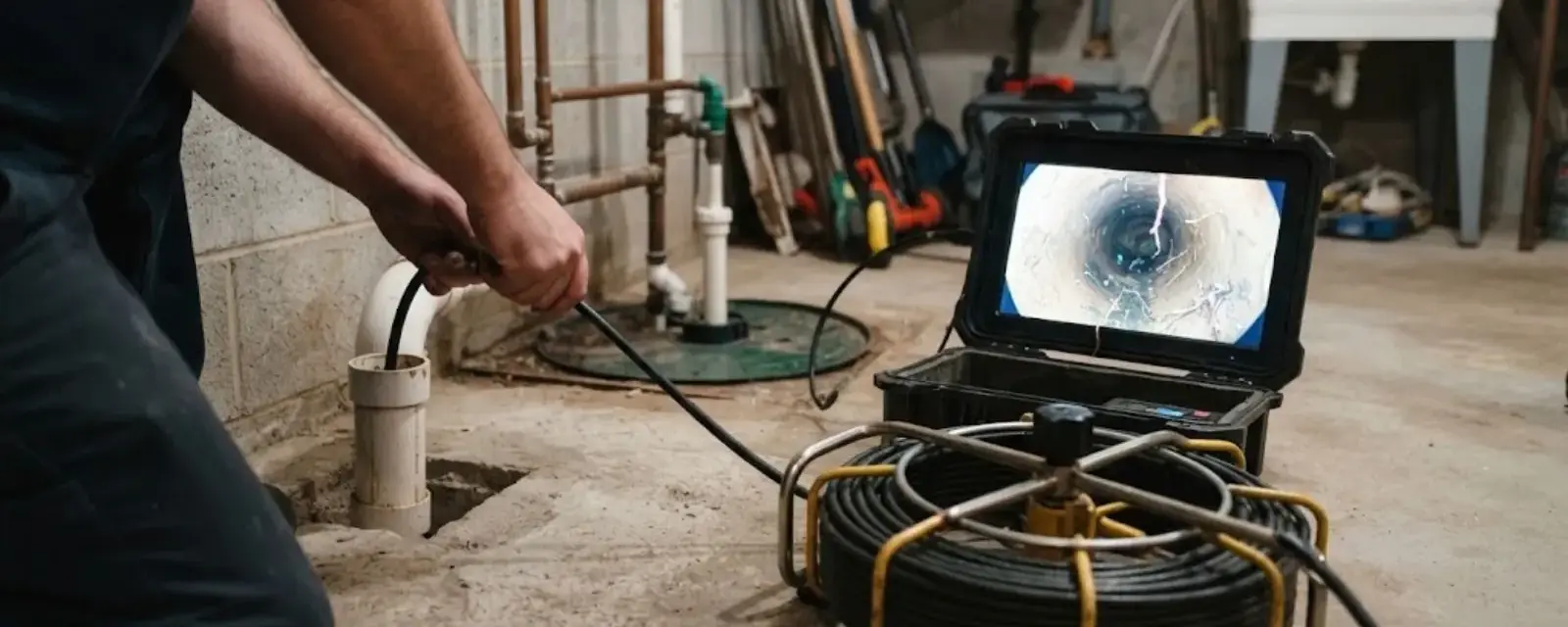
When a basement floor drain backs up, stop running water in the house right away and keep people and pets out of the wet area. That means no laundry, no dishwasher and no flushing until you know what is blocked. A floor drain sits at the lowest point of your plumbing, so it is the first place a blockage downstream shows itself.
This guide is for Randolph, NJ homeowners. It covers common causes, how to tell a clogged branch drain from a sewer line problem, who to call, how to clean up without getting sick, and what to ask the township about backwater valves.
The first ten minutes, in order
- 1
Stop adding water
Skip showers, laundry, the dishwasher and toilet flushes. Every gallon you send down may end up on the floor.
- 2
Keep power away from water
If water is near outlets, a furnace, a water heater or a panel, stay out and do not touch anything electrical while standing in it.
- 3
Look at what is coming up
Clear water from a laundry tub is a different problem from dark, foul-smelling water carrying waste.
- 4
Check other fixtures
Gurgling toilets, slow sinks upstairs or a bubbling tub point to a shared line, not just the floor drain.
- 5
Call a plumber
Tell us what is coming up, which fixtures are slow, and whether anything else in the house has changed.
Drain line or sewer line: reading the clues
A floor drain connects to the main drain that carries everything in the house toward the sewer or septic tank. A clog in a short branch affects one fixture. A clog in the main, or in the lateral that leaves the house, affects the lowest drains first, and that is the basement.
| What you notice | Points to | Typical response |
|---|---|---|
| Only the floor drain is slow, nothing else | Clog or buildup in its own branch | Cable clearing of the branch |
| Floor drain backs up when the washer drains | Shared drain with a partial blockage | Clear the line, inspect with a camera |
| Toilets gurgle and the floor drain bubbles | Main drain or vent problem | Stop water use, call a plumber |
| Several fixtures slow, sewage smell | Main line or lateral blockage | Sewer line cleaning and a camera inspection |
| Backup follows heavy rain, other fixtures fine | Groundwater or storm inflow, sump trouble | Check sump, ask about flood protection |
| Repeats every few months | Roots, a belly, a crack or heavy buildup | Camera inspection, then jetting or repair |
What usually blocks a floor drain
The common causes are grease and soap buildup, lint and hair from laundry, mud and debris washed in from outside, and roots that have found a joint in a buried line. Older clay or cast iron lines can also sag or crack, which gives debris a place to collect.
A floor drain trap can also fill with sediment over the years. If a drain gurgles and smells but has never backed up, the trap or the line behind it may be partly blocked. Pouring chemicals into a floor drain rarely helps, because the blockage is often farther away than the product reaches.
Our crews clear a stoppage with sewer line cleaning using a cable machine sized to the pipe. When we hit buildup that a cable only pokes through, we recommend hydro-jetting to wash the pipe wall.
Randolph, NJ: find out who owns the next link in the line
Randolph's township sewer system has 82 miles of sanitary sewers and 10 pumping stations. The township does not own a wastewater treatment plant, and the RVRSA service area covers most of the north and east, including the Route 10 area, while the Butterworth service area is the southern half along Sussex Turnpike. If a sewer line appears to be the cause, knowing which service area your address falls in helps you ask the right office the right question.
The township Division of Water and Sewer has a listed number on the township Water and Sewer page. After hours, the emergency route goes through police dispatch. If your basement is taking on sewage, you may not know whether the blockage is in your pipe or in the street main. A short call to the Division tells you whether neighbors are reporting the same thing. Make that call before you pay for work on your own line.
Source type: Township Water and Sewer page, Division contact list
Who does what when a basement drain backs up
Your own pipes, from the fixture to the point where the line leaves your property, are your responsibility. A plumber can clear those and find whether the blockage is inside the house or out in the lateral. Utility crews work on the public main.
Call us first for a blockage you can trace to your own pipes. Call the township Division if several neighbors have backups at once, or if your plumber finds the blockage past your property. A camera run shows where the problem sits, and our sewer inspection gives you something to show the township if the issue is theirs.
We serve Randolph and the towns around it, including Dover and Morris Township, where the same basement drain questions come up after heavy rain.
Cleaning up safely after a backup
Treat sewage water as contaminated. Wear rubber boots, gloves and eye protection, keep children and pets away, and wash hands well afterward. Open windows for air and run a fan, but do not wade in while electrical equipment is nearby.
Hard surfaces can be washed and disinfected. Carpet, drywall and cardboard that soaked up contaminated water are usually thrown away. Take photos before you start, since your insurer may want to see the damage.
Once the line is cleared and the water stops rising, let a plumber confirm the drain runs freely before you resume normal use. Running the washer on a half-cleared line is how a second backup happens.
The backwater valve question
A backwater valve is a one-way valve installed in the sewer lateral or a floor drain line so sewage cannot flow backward into the house. FEMA's basement flooding guide notes that check valves can become jammed open by debris, and that homeowners should ask local officials whether such valves are permitted.
So a valve is not a set-and-forget fix. It needs access for inspection and cleaning, and it has to be installed correctly. Ask the Randolph Office of Construction Codes whether a valve is permitted for your project and whether a permit applies before anyone cuts into the line, since the township says plumbing modifications generally need a permit and approvals.
Valves also do not replace maintenance. A line with roots or buildup that is cleaned on schedule backs up less than a clogged line fitted with a valve.
Floor drain backup questions
Heavy rain can overload a sewer or fill the ground around your foundation. If only the floor drain acts up in wet weather, the cause may be storm inflow or a sump system that is not keeping up. A camera look helps separate those from a plain clog.
If sewage is rising, water is near electrical equipment, or you cannot stop it, treat it as urgent and call right away. A slow drain with no standing water can wait for a normal appointment, but keep water use low until it is checked.
You can try a hand auger on a short branch. Unlicensed people are allowed to clear drain stoppages in New Jersey, but a clog that returns or backs up several fixtures usually sits in the main, where a machine and a camera do the job properly.
A camera run shows where the pipe is blocked. If the blockage sits in your lateral, it is yours to repair. If other houses on the street back up too, call the township Division.
It can, when it is installed correctly and kept clear. FEMA warns that check valves can jam open with debris, and recommends asking local officials whether they are permitted. It is one layer of protection, not a replacement for cleaning the line.
Call us for your own plumbing. If you think the township main is involved, the Division of Water and Sewer handles it by day, and the after-hours emergency route goes through police dispatch. Both numbers are on the township Water and Sewer page.
Water coming up through the floor? Call us now and tell us what you see.
Call (908) 357-1542Standards and sources used on this page
- Randolph Township, Office of Construction Codes, construction permits page
- Randolph Township Water and Sewer page and Utilities Element
- FEMA guide to reducing basement flooding