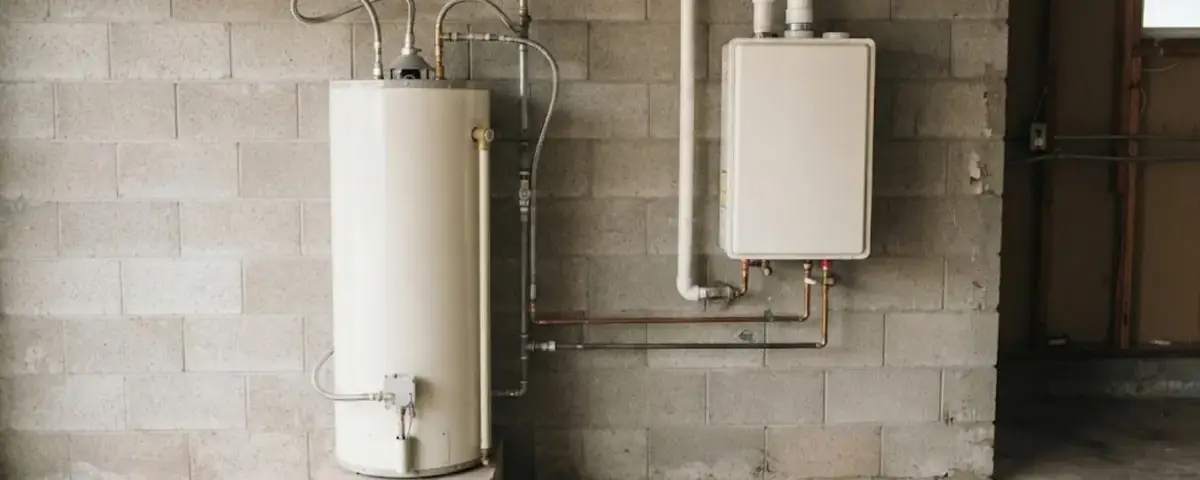
The cost of installing a hot water heater depends on six things: the unit type and size, the fuel and venting it needs, how hard the old unit is to remove, the permit and inspection, and any code upgrades the new unit triggers. We do not quote figures in a blog post, because two houses on one street can land far apart. We can show you which factors move a quote up or down.
If you live in Randolph, NJ, the township also has rules about permits and who may do the work. Both affect what you are buying and who you hire, so they are covered below along with the water temperature setting that protects your family.
The quote, line by line
A written installation price has several parts. Some are fixed by the unit you pick, some by your house, and some by the paperwork. Ask any plumber to break the price into these lines so you can compare quotes fairly.
| Cost factor | What it covers | What pushes it up |
|---|---|---|
| The unit | Tank, tankless or hybrid heater itself | Higher capacity, higher efficiency, more features |
| Fuel and venting | Gas, electric, or heat pump, and the vent or flue path | Moving a vent, new flue liner, condensate drain |
| Removal and haul-away | Draining and removing the old unit | Tight stairs, a corroded unit that is hard to move |
| Plumbing connections | Water lines, shutoffs, expansion tank, relief valve and discharge pipe | Corroded old fittings, missing shutoffs, long pipe runs |
| Electrical or gas work | Dedicated circuit or gas line sizing | Upsizing a gas line for tankless, adding a circuit |
| Permit and inspection | Construction permit and a final check | Waiting on scheduling, extra corrections |
| Timing | Emergency or after-hours call versus planned work | Urgent replacement outside normal hours |
Tank, tankless or hybrid: how the choice changes the bill
A traditional tank heater is the simplest to install. It stores hot water, so it needs a drain, a relief valve and a place to stand. It usually costs the least up front and the most to run, since it keeps a tank hot around the clock.
A tankless unit heats water as it flows, so it needs enough gas or electrical capacity to heat quickly and often larger gas piping and a different vent. Installation is usually more involved, so expect a higher installation bill and lower standby loss. Our tankless water heater page explains sizing in plain terms.
A hybrid, or heat pump, water heater uses electricity to move heat from the surrounding air into the tank. It needs space, airflow and a place for condensate to drain. It often costs more at purchase and less to operate, and a cramped utility closet can rule it out.
Sizing is a cost decision, not just a comfort one
A unit that is too small runs out of hot water and works harder, and one that is too large costs more to buy and to keep hot. For tank units, the number of people and bathrooms and the pattern of morning showers are the main inputs. For tankless units, the question is how many fixtures run at once and how much the water must be warmed.
Tank gallons do not convert directly to tankless capacity, so a plumber should size each by its own rules. Bring a list of what runs at the same time: showers, a washing machine, a dishwasher. That list shapes the model and the price.
Randolph, NJ: the permit step and who may install
Randolph's Office of Construction Codes says a water heater replacement needs a construction permit, and no zoning approval applies to a water heater. The plumbing subcode form is signed and sealed by a licensed plumber unless the work is done by a homeowner in an owner-occupied single-family dwelling. In practice, that puts the permit and inspection on your quote, so ask any plumber who will pull the permit and whether it is priced in.
New Jersey rules say plumbing work shall only be performed by a master plumber, an authorized plumbing contractor, or employees working under a master plumber's supervision, with an exception for a single-family homeowner working in his or her own dwelling. That is why a low quote from someone who cannot show a license is a warning sign. You can check a plumber through the state's license verification system.
The Consumer Product Safety Commission urges lowering water heaters to 120 degrees F, and notes that most adults suffer third-degree burns from 2 seconds at 150 F and 6 seconds at 140 F. Ask the installer to set the new unit to 120 F before they leave, especially if children or older adults live in the house.
Source type: Township Construction Permits page, N.J.A.C. plumbing rules, CPSC guidance
When replacement beats another repair
A leak from the tank itself means the tank is done, and no repair fixes a corroded shell. Rusty hot water, rumbling from sediment and a unit that has needed repeated work all point toward replacement. A bad thermostat, element or pilot assembly on an otherwise sound unit can still be fixed.
If you are choosing between the two, ask for both prices. Our water heater replacement team will explain what each option leaves you with, and tell you plainly when a repair is not worth the money.
Honest ways to keep the installation price down
Some savings are real and some cost you later. Keeping the same fuel type and the same location avoids new gas lines, circuits and venting. Choosing the right size, not the biggest, saves money at purchase and on every bill after.
- Keep the heater in its current spot when the room allows
- Clear a path to the unit so removal takes less time
- Ask for the permit to be itemized so nothing is hidden
- Replace a failing unit before it leaks, not after, to avoid water damage and urgent scheduling
- Skip add-ons you do not need, but keep the relief valve and discharge pipe
What happens on installation day
- 1
Shut off and drain
The plumber closes the fuel or power supply and the water, then drains the old tank.
- 2
Remove and prepare
The old unit comes out and the connections, vent and drain path are checked or corrected.
- 3
Set and connect
The new heater is set, piped, vented, and fitted with a relief valve and discharge pipe.
- 4
Test and set temperature
The plumber checks for leaks, confirms combustion or heating, and sets the thermostat.
- 5
Inspection
The permitted work is ready for the township inspection.
Neighbors in Rockaway Township and Denville follow the same steps, though each town has its own construction office and its own permit rules. Our water heater installation page lists what we install.
What to do before the installer arrives
A little preparation keeps an install on schedule and keeps the work area safe.
- Clear a path to the old heater and a few feet of space around it. Move stored boxes and paint cans away from the unit.
- Know where your main water shutoff is, and tell the plumber if it does not close fully.
- Check that a working carbon monoxide alarm is near the sleeping areas, especially with a gas or oil unit.
- Ask for the thermostat to be set at 120 F, which CPSC recommends to lower scald risk.
- Ask the Randolph Office of Construction Codes about the permit before the work starts. Replacing a water heater needs a construction permit in Randolph.
Installation cost questions
Because the unit, the venting, the fuel line or circuit, the removal and the permit all change from house to house. Ask each plumber to list those items so the quotes compare like for like.
Usually, because it may need larger gas piping or a bigger electrical supply and a different vent. It can save on operating cost, but the installation scope is larger. A plumber should size it by the flow and temperature rise you need.
Yes. It pulls heat from the air around it, so it needs room, airflow and a condensate drain. A tight, closed closet may not work.
Randolph's Office of Construction Codes lists water heater replacement as needing a construction permit, with no zoning approval required. Ask your plumber who pulls it, and call the office during planning, as the township suggests.
New Jersey allows a single-family homeowner to do plumbing in his or her own dwelling. The township still requires the permit, and gas, venting and relief valve mistakes carry real risk. Many owners hire a licensed plumber for that reason.
The Consumer Product Safety Commission urges 120 degrees F. At 140 F, an adult can suffer a third-degree burn in about 6 seconds, so ask for 120 F on the day of installation.
Ready for a clear price on your water heater? Call us and tell us what you have now.
Call (908) 357-1542Standards and sources used on this page
- Randolph Township, Office of Construction Codes, construction permits page
- N.J.A.C. 13:32-1.4, plumbing practice rules
- NJ Division of Consumer Affairs, license verification system
- U.S. Consumer Product Safety Commission, tap water scald guidance
- U.S. Department of Energy, Energy Saver guide to sizing a new water heater
- NJ Korman and Park's Law, P.L. 2015, c.146