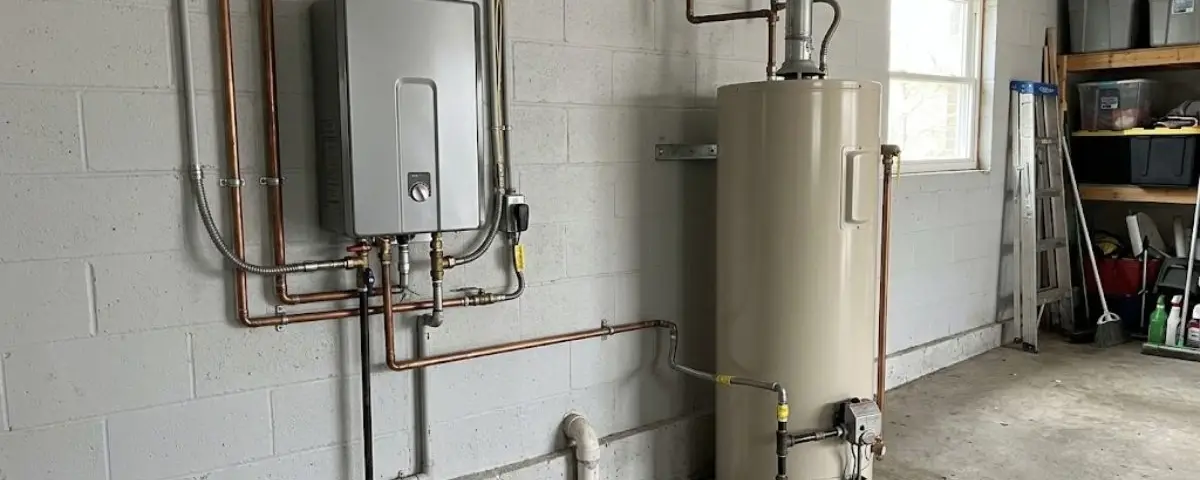
No tankless water heater is the equivalent of a 50 gallon tank, because the two are measured in different units. A tank is sized by how much hot water it stores. A tankless unit is rated by the temperature rise it can deliver at a given flow rate, in gallons per minute. To replace a 50 gallon tank in Randolph, NJ, you size the new unit to the most hot water you use at one time.
The method below follows the Department of Energy approach. It takes about ten minutes with a pencil, and it keeps you from buying a unit that runs out of hot water on a busy morning.
Why gallons do not convert to GPM
A 50 gallon tank holds a reserve and recovers slowly. A tankless unit holds almost nothing and heats water as it flows. The reserve is irrelevant to the new unit, so the old tank size tells you very little.
What matters is how many fixtures run together and how cold your incoming water is. Two showers and a dishwasher at once is a very different load from a single bathroom sink.
The sizing method in four steps
- 1
List the fixtures used at the same time
Think about your busiest hour. Which taps, showers, appliances would run at once?
- 2
Add up their flow rates
Each fixture has a flow rating in GPM. Add the ones that overlap.
- 3
Work out the temperature rise
Subtract the incoming water temperature from the temperature you want out of the tap.
- 4
Match a unit rated for that flow at that rise
Check the maker's chart, which lists GPM available at each rise. Pick a unit that meets or beats your number.
A worked example with real numbers
Say the household runs a bathroom faucet at 0.75 GPM while someone showers at 2.5 GPM. That is 0.75 plus 2.5, or 3.25 GPM. The DOE guide assumes water comes in at 50 degrees F and leaves at 120 degrees F unless you know otherwise, so the rise is 70 degrees F.
A gas unit typically delivers about 5 GPM at a 70 degree rise, so it covers the 3.25 GPM load with room to spare. An electric unit typically delivers about 2 GPM at that rise, so it falls short of the shower alone.
Now add a second shower at 2.5 GPM. The total becomes 5.75 GPM, which is more than a typical 5 GPM gas unit can deliver at a 70 degree rise. That household needs a larger gas unit, or a plan to avoid running both showers together.
Fuel and household size at a glance
| Scenario | Flow needed | Typical gas unit (about 5 GPM) | Typical electric unit (about 2 GPM) |
|---|---|---|---|
| One shower alone | 2.5 GPM | Covers it | Falls short |
| Shower plus bathroom faucet | 3.25 GPM | Covers it | Falls short |
| Two showers | 5.0 GPM | At the limit | Falls short |
| Two showers plus a faucet | 5.75 GPM | Falls short | Falls short |
Treat the table as a screening tool. Real units vary by model, and the maker's chart is the final word.
Randolph, NJ: gas availability and the permit
New Jersey Natural Gas has installed, or is installing, gas main in parts of Randolph, including Millbrook Avenue in 2026 and Route 10 westbound in 2025. We do not claim it serves every address. Homes here may use gas, oil or propane, so the first question before choosing a tankless unit is whether your house has natural gas available at the street and at the meter.
The gas question matters because the DOE figures show gas tankless units delivering far more flow than electric ones. If your house is on oil or propane, the options and the venting change, and a plumber should walk the house before you buy. Ask the gas utility whether your address can be connected.
Replacing a water heater in Randolph needs a construction permit, and the township page says no zoning approval is required for a water heater. Switching to tankless often means new gas piping and a new vent, so call the Office of Construction Codes during planning to confirm what your project will need.
Source type: DOE Energy Saver, Morris County news and township permit page
Gas line and vent checks before you buy
- Is the existing gas pipe large enough to feed a tankless burner, which draws more fuel at once than a tank burner?
- Does the vent need to change to a different material or a new route?
- Is there a condensate drain nearby, if the unit is a condensing model?
- Is there an electrical outlet nearby for the unit's controls?
- Is the water supply pressure and pipe size adequate for the rated flow?
If you smell gas at any point, leave the building first, then call the gas utility or 911 from outside.
Common sizing mistakes
Sizing by tank gallons
A 50 gallon label tells you nothing about flow. Use GPM and rise.
Ignoring cold incoming water
A colder supply means a higher rise, which lowers the flow a unit can deliver.
Forgetting overlap
The dishwasher and laundry may run while someone showers. Count them.
Skipping the gas line
A great unit with an undersized pipe will cut out under load.
Planning a tankless swap with our team
We start with a walk-through, count fixtures, check the gas supply and vent route, and then recommend a size. You can read more about our tankless water heater work and our water heater installation process. If you are in Dover or Rockaway Township, we cover those towns too.
A tankless unit also needs periodic flushing to remove scale, so ask about service when you choose a model.
Tankless sizing questions
No single size does, because tankless units are sized by GPM and temperature rise rather than storage. Add up the fixtures you use at once and match a unit to that flow.
Add the flow rates of the fixtures running together. A faucet at 0.75 GPM plus a shower at 2.5 GPM gives 3.25 GPM.
It is the desired outlet temperature minus the incoming water temperature. At 50 degrees F in and 120 degrees F out, the rise is 70 degrees F.
At a 70 degree rise, a typical gas unit delivers about 5 GPM and an electric one about 2 GPM. Gas usually handles larger loads, but gas availability and venting decide whether it is practical.
Maybe. Tankless burners draw more fuel at once, so the line size and length must be checked. A plumber measures it before you buy.
New Jersey Natural Gas has installed or is installing main in parts of Randolph, but not every address is served. Ask the gas utility about your street and meter, and note that some Randolph homes use oil or propane.
Want a sizing check for your house? Call and tell us how many showers run at once.
Call (908) 357-1542Standards and sources used on this page
- Randolph Township, Office of Construction Codes, construction permits page
- U.S. Consumer Product Safety Commission, tap water scald guidance
- U.S. Department of Energy, Energy Saver guide to sizing a new water heater
- PSEG public safety guidance on gas leaks (used as a general reference)